How To Optimize Your Google Business Profile In 6 Steps: A DFW Service Provider’s Guide
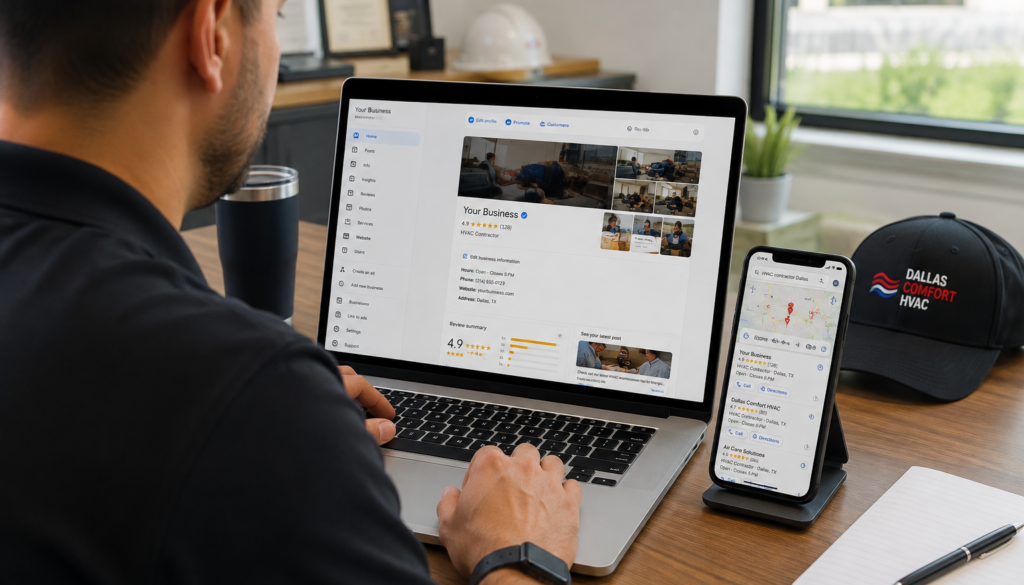
Your Google Business Profile controls what shows up when someone searches for your services on Google Maps. For service providers across Dallas, Fort Worth, and the DFW metroplex, this is where most local leads start. A well-optimized profile generates calls. A neglected one gets scrolled past.
The problem is that most DFW service businesses set up their GBP once and never touch it again. The categories are vague, the description is generic, the photos are stock images or nonexistent, and reviews sit unanswered for months. Meanwhile, the competitor who maintains their profile consistently is getting the calls that should be going to you.
This guide covers the six steps that actually move the needle, in the order you should do them. If you’re serious about local SEO in Dallas, your GBP is where the work starts.
Step 1: Audit Your Primary And Secondary Categories
Getting your categories right is the single most impactful on-page factor for local pack rankings. Before you write your description or upload photos, fix this first.
Your primary category should match your highest-margin core service. Be specific. “Roofer” and “Roofing Contractor” are distinct options in Google’s taxonomy, and picking the wrong one means competing for the wrong searches. A Fort Worth roofing company that selects “Roofer” when their actual work is commercial roof installation is sending the wrong signal.
Add up to five secondary categories that reflect services your DFW customers are actively searching for. A roofer who also handles gutters and siding should add “Gutter Cleaning Service” and “Siding Contractor” if those are real services they sell.
Remove any categories that don’t match a service you actively offer. Irrelevant categories weaken your relevance signals. Google treats category selection as a declaration of what your business does. Listing categories for services you don’t provide dilutes the signal for the ones you do.
How to check what’s working: Look at the competitors showing up in the Dallas map pack for your target keywords. Tools like BrightLocal or Localo let you see which categories they’re using. If a competitor ranks above you and uses a more specific primary category, that’s a gap worth closing.
Google’s category weighting works on a hierarchy. Your primary category carries the most influence. Secondary categories add supporting relevance. Categories beyond your core services work against you. Choose deliberately.
Step 2: Write A Business Description That Targets DFW Searches
Your GBP description gives you 750 characters. Most Dallas service providers waste them on copy that could describe any business in any city. The businesses getting calls from their profile are the ones whose descriptions tell Google and the searcher exactly what they do and where.
Front-load your core service and location in the first 250 characters. Google truncates descriptions in the map pack preview, so lead with what matters. “Dallas plumber serving Plano, Frisco, and Irving” beats a brand story that buries the service below a paragraph of background.
Name specific DFW suburbs and neighborhoods. Lakewood, Allen, McKinney, Southlake, Oak Cliff. Listing specific areas signals relevance to both the algorithm and a local reader who wants to know if you actually serve their part of the metroplex. “DFW” and “North Texas” alone are too broad to carry that signal.
Reference recognizable local landmarks or corridors. Mentioning the Tollway corridor or Preston Road area reinforces geographic authority naturally.
Read it out loud before you publish. If it sounds like it was written for an algorithm rather than a person, trim it. Keyword stuffing damages credibility with readers and does nothing for rankings.
Before: “We provide plumbing services with years of experience and great customer service.”
After: “Dallas plumber serving Plano, Frisco, and Lakewood. Same-day repairs along the Preston Road corridor. Licensed, local, and trusted by DFW homeowners since 2011.”
The first version could describe any plumber anywhere. The second tells Google and the searcher exactly who this business is, where they work, and why someone should call. If your website messaging doesn’t match your GBP description, fix that too. Consistency between your profile and your site strengthens both.
Step 3: Build A Consistent Review Response System
Reviews affect both your local rankings and whether someone calls you after finding your profile. Whitespark’s Local Search Ranking Factors study consistently ranks review signals as one of the top-weighted local pack factors. But the part most businesses miss isn’t getting reviews. It’s responding to them.
Respond to every review within 24 to 48 hours. Set a daily reminder. Unanswered reviews, positive or negative, signal low engagement. Google’s systems track this.
Include service and location terms in your responses naturally. When a customer reviews your HVAC work, your response can reference “AC repair in Frisco” or “same-day service in Plano” without sounding forced. This reinforces your geographic and service relevance.
Handle negative reviews with a resolution focus. Acknowledge the concern, offer a direct contact method, keep it professional. Don’t argue. The people reading your response are potential customers deciding whether to trust you. How you respond matters more than the complaint itself. Our guide on turning reviews into local SEO wins covers this in more detail.
Ask customers to mention their DFW suburb. After completing a job, ask satisfied customers to include their city in the review text. “Great AC repair in Southlake” carries more geographic relevance than “Great service.” You can’t control what they write, but a simple ask goes a long way.
Track review velocity, not just star rating. A steady stream of new reviews signals an active, credible business. Consistency matters more than occasional bursts. Aim for 2 to 4 new reviews per month at minimum.
Step 4: Upload Real Proof-of-Work Photos
A visually complete GBP drives more calls than one with stock photos or no images at all. BrightLocal’s research has consistently shown that profiles with more photos generate significantly more calls and direction requests. For DFW service providers, your photo strategy should prove that you do real work in real neighborhoods.
Every Dallas-area profile needs these photo types at minimum:
- Team photos showing branded uniforms or vehicles
- Active job site shots at recognizable DFW locations
- Before-and-after comparisons specific to your service
- Equipment and tools that show professionalism
- Completed project results with real-world context
Geotag every image to your service area before uploading. Free metadata editors let you embed latitude and longitude directly into image files. This reinforces your geographic relevance.
Photograph your team at actual job sites across Plano, Frisco, Oak Cliff, and other DFW neighborhoods rather than staging indoor shots that could have been taken anywhere.
Remove all stock photography. Generic images reduce trust and signal low authenticity to both Google and the people looking at your profile.
Capture branded trucks or vans with your company name visible. This reinforces local presence in a way stock photos never can.
Upload at least 3 new photos per week to demonstrate consistent activity. Google treats profile freshness as a relevance signal.
Name files descriptively. “roof-repair-dallas-tx-lakewood.jpg” tells Google more than “IMG\_4021.jpg.”
Step 5: Fix Your NAP Consistency Across DFW Directories
NAP stands for Name, Address, Phone number. If these details don’t match exactly across your website, Google Business Profile, Yelp, Bing Places, Apple Maps, BBB, and local chamber listings, you’re creating confusion that weakens your local ranking signals.
A single mismatched phone number on a forgotten directory listing can quietly hold your profile back. “123 Main St” on your website and “123 Main Street” on Yelp might look the same to you, but Google treats inconsistencies as a reliability issue.
Run a citation audit at least once per quarter. Check every major DFW directory where your business appears and fix any mismatches. This includes chamber of commerce listings, industry directories, and data aggregators like Data Axle and Neustar Localeze.
If your business moved, changed phone numbers, or rebranded at any point, there are almost certainly old listings with outdated information. Finding and fixing these is one of the fastest ways to strengthen your local signals.
NAP consistency is one of the foundational elements of local SEO. If your citations are a mess, the rest of your optimization work can’t perform at its potential. Our SEO services include citation audits as a standard part of local campaigns for this reason.
Step 6: Stay Active With Google Posts And Weekly Updates
A GBP that hasn’t been updated in months looks dormant. Google rewards active profiles with better visibility, and potential customers who see recent posts and fresh photos are more likely to call.
Publish Google Posts weekly. Highlight Dallas-specific seasonal offers: summer AC tune-up specials, pre-storm roofing inspections, end-of-year tax prep reminders. Posts keep your profile active and give you another opportunity to include location and service terms.
Share completed projects. Brief updates about recent work build more trust than generic promotional posts. “Just finished a full roof replacement in Plano. 30-year architectural shingles, completed in two days.” That’s specific. That’s real. That’s what makes someone call.
Announce service area expansions or new capabilities. Starting to serve a new DFW suburb or adding a new service? Post about it. This signals relevance to both Google and potential customers in that area.
Respond to Q&A on your profile. If customers ask questions on your GBP, answer them quickly and specifically. Unanswered questions make the profile look unmonitored.
Your Google Posts also feed into how AI search platforms evaluate your business. Active, content-rich profiles give systems like Google AI Overviews and ChatGPT more information to work with when generating local recommendations. Businesses showing up in AI search results tend to have the most complete and actively maintained profiles.
What To Do Next
These six steps work in sequence. Categories first, because everything else builds on having the right relevance foundation. Description second, because it tells Google and searchers what you do and where. Reviews third, because they build trust and ranking signals simultaneously. Photos fourth, because visual proof converts profile visitors into callers. NAP consistency fifth, because broken citations undermine everything above. Activity sixth, because maintaining your profile is what keeps you in the top positions after you earn them.
If you’re a service provider in Dallas, Fort Worth, or anywhere across the DFW metroplex and your GBP isn’t generating the calls it should be, something in this sequence needs attention. Most businesses we audit have gaps in at least three of these areas.
DFW Website SEO offers a free Google Business Profile audit that shows you exactly where your profile stands and what’s holding it back. We’ve helped over 1,000 DFW businesses optimize their local presence over the past 13 years, and GBP optimization is where nearly every local SEO engagement starts.
Request a free GBP audit or call us to find out what your profile is leaving on the table.

CORPORATE OFFICE
2001 N Lamar Street
Suite Number 270
Dallas, TX 75202