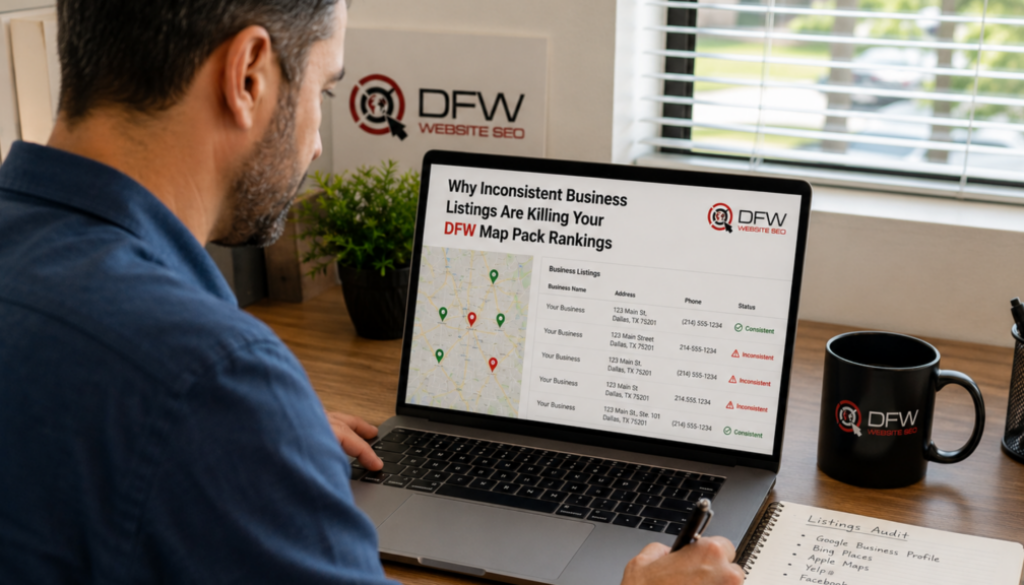
Why Inconsistent Business Listings Are Killing Your DFW Map Pack Rankings
A competitor with fewer reviews and a worse website is sitting above you in the Google Maps three-pack. You’ve checked your Google Business Profile twice. Your services are listed. Your hours are correct. You can’t figure out what they have that you don’t.
There’s a good chance the problem is hiding in places you haven’t looked: your business name, address, and phone number don’t match across the web. An old phone number on Yelp. A previous address still listed on a directory you signed up for three years ago. A slightly different business name on Facebook. These mismatches tell Google that your business information can’t be fully trusted. And when Google can’t trust the data, it shows a competitor whose data is clean.
Consistent business information is a local SEO trust signal. Fractured data, usually left behind after a move, a rebrand, or a phone number change, quietly holds you back. This guide shows you how to find it and fix it.
What local citations actually mean (in plain English)
A citation is any online mention of your business name, address, and phone number. The SEO world calls these “NAP” (Name, Address, Phone).
Structured citations are listings on directories like Yelp, Facebook, BBB, Apple Maps, and Bing Places. Unstructured citations are mentions on blogs, news articles, or local websites without a formal profile format.
Behind the directories you see, a few big companies called data aggregators (Data Axle, Foursquare, and others) feed your business information to hundreds of smaller sites. If your data is wrong at the aggregator level, that error spreads to listings you didn’t create and may not know about.
Google uses these citations to verify that your business exists and is located where you say it is. When your information matches everywhere, it’s a trust signal. When it doesn’t, Google has less confidence showing you.
The hidden reason your Dallas business isn’t in the map pack
Google’s local ranking factors include relevance, distance, and prominence. Part of how Google measures prominence is checking whether your business information is consistent across the web.
Think of it like a GPS given three different addresses for the same restaurant. It doesn’t average them. It picks a different restaurant.
When Google finds conflicting phone numbers or addresses for your business, it can’t confidently show any of them. So it shows a competitor whose details match instead. In a metro as dense as DFW, this small difference decides who lands in the top three.
The cost of inconsistency: old addresses, new numbers, duplicate listings
This is the part most citation guides skip over, but it’s the part that describes what’s actually happening to most DFW service businesses.
You moved offices. Your current address is on your website and Google Business Profile, but Yelp still shows the old address. So does an industry directory you signed up for in 2019. A Fort Worth HVAC company in this exact situation slipped out of the map pack until the old addresses were cleaned up.
You changed your phone number. The new number is on your website, but the old one lives on six directories and a data aggregator that’s feeding it to 30 more sites. A contractor whose old number still rings on an outdated directory is sending potential leads to a dead line.
You rebranded. Your business name appears as “Smith Plumbing,” “Smith Plumbing LLC,” and “Smith Plumbing Services” across different sites. To Google, those could be three different businesses, and the reviews and authority you’ve built get split instead of stacked.
Duplicate listings exist. A Dallas dentist discovers two Google Business Profile listings for the same practice, with reviews split between them and patients confused about which one is real. Duplicate listings divide your signals and weaken both.
Adding more citations doesn’t fix any of this. If the foundation is wrong, new listings just multiply the confusion. You have to audit and fix before you build.
An audit-first approach to fixing your DFW presence
This is the process that actually works. Don’t build new citations until you’ve cleaned up the old ones.
- Write down every address and phone number your business has ever used. Go back to your first location. Include any phone numbers you’ve retired. This list is your search map for finding ghost listings.
- Search for your business name and old numbers to find ghost and duplicate listings. Search Google for your business name in quotes. Search each old phone number. Search each old address. You’ll find directory listings, aggregator entries, and mentions you forgot about. Check Yelp, Facebook, Apple Maps, Bing Places, BBB, Yellow Pages, and Angi specifically.
- Fix the Big Four first: Google Business Profile, Facebook, Apple Maps, Bing Places. These carry the most weight and feed into the most other platforms. Get your NAP correct on these four before touching anything else. If you have a duplicate Google Business Profile, claim and merge or remove it through Google’s support process.
- Work through the data aggregators and general directories. Update your information at the aggregator level (Data Axle, Foursquare) so corrections flow downstream. Then fix the remaining directories manually. Yelp, BBB, Angi, Thumbtack, and any industry-specific directories where your business appears.
- Add the DFW-specific listings that matter. Dallas Regional Chamber, Fort Worth Chamber, local business associations, and any reputable DFW-area directories relevant to your industry. These carry local authority weight that generic national directories don’t.
If you’d rather not spend a weekend hunting down old listings and recovering forgotten passwords, our team handles citation cleanup as part of every local SEO engagement.
Where to build: directories that actually move the needle in North Texas
The essentials (fix first, most weight): Google Business Profile, Apple Maps, Bing Places, Facebook, Yelp
The aggregators (fix to stop errors spreading): Data Axle and Foursquare feed your information to hundreds of smaller sites. Fixing your data here is like repairing the source of a leak instead of mopping the floor.
Industry-specific sites: A roofer needs Angi, HomeAdvisor, and Thumbtack. A dentist needs Healthgrades and Zocdoc. A lawyer needs Avvo, FindLaw, and Justia. Match your presence to where your customers look.
DFW-local directories: Dallas Regional Chamber, Fort Worth Chamber, city-specific directories, and local trade associations. These carry geographic authority that national directories can’t provide.
A warning about automated tools: Services that submit you to 300+ directories for a monthly fee are mostly building listings on sites with no traffic and no value. Worse, some create listings you can’t control or delete. A handful of accurate listings on the right directories beats hundreds of sloppy ones.
How NAP consistency now feeds AI answers too
This is the angle none of the competing articles cover.
AI tools like Google AI Overviews, ChatGPT, and Perplexity rely on consistent business data across the web to trust and reference a business. The same clean NAP information that wins the map pack now also helps you show up in local AI search answers.
When AI systems see matching business information across your website, GBP, directories, and mentions, they can confidently identify your business as a real entity and connect it to relevant local queries. When the data conflicts, they skip you the same way Google’s traditional algorithm does. Consistent data is now a trust signal across both search systems.
The bottom line
- NAP consistency is the foundation of local trust. Everything else in local SEO builds on it.
- Fixing wrong data matters more than adding new listings. Audit before you build.
- A handful of accurate, authoritative listings beats a hundred sloppy ones.
- The moved, rebranded, or changed-number scenarios are where most DFW businesses have hidden problems.
- DFW-local citations from chambers and area associations give a real edge in a crowded metro.
How DFW Website SEO helps
Cleaning up messy citations is tedious work. It means chasing old logins, contacting directory support teams, merging duplicates, and updating dozens of sites one at a time. Then it means keeping everything consistent as your business evolves.
We do this for Dallas and Fort Worth businesses as part of our local SEO services. We’ve handled citation cleanup and management for over 1,000 clients across 13 years. One of our Dallas retail clients grew their business 5x with local SEO that included thorough citation work as a foundation.
We won’t promise that fixing your citations will put you in the map pack by next Tuesday. But we can tell you that leaving them broken makes it significantly harder to get there.
Ready for a citation audit?
If you’re not sure whether inconsistent listings are holding your DFW business back, we can find out. DFW Website SEO offers a free local citation audit that shows you exactly where your NAP data conflicts and what to fix first.
Request a free citation audit or call us to talk through your situation.

CORPORATE OFFICE
2001 N Lamar Street
Suite Number 270
Dallas, TX 75202