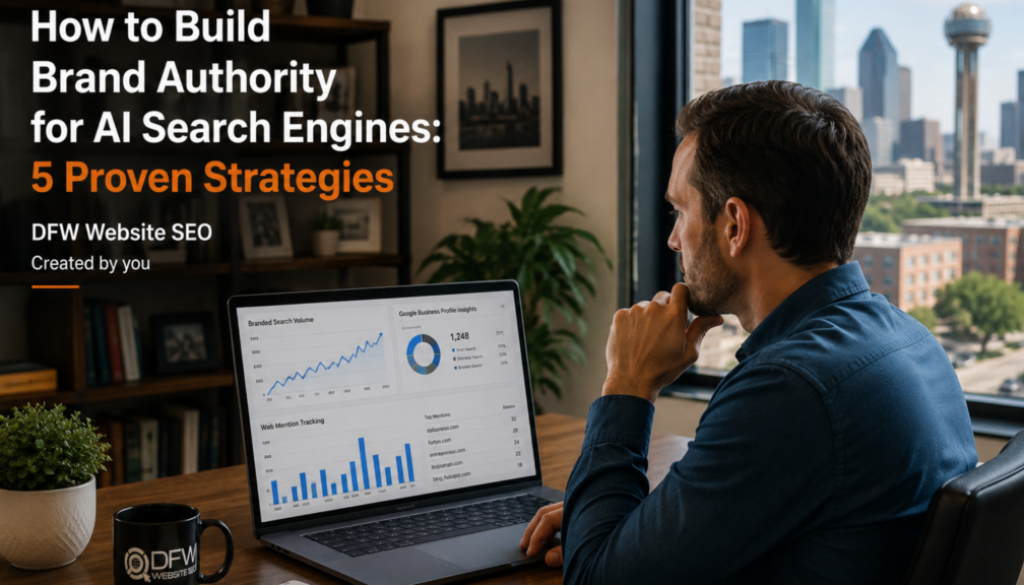
How To Build Brand Authority For AI Search Engines: 5 Proven Strategies
AI search engines don’t just pull from whatever page happens to rank. They cite brands they recognize and trust. That makes brand authority a visibility factor now, not just a branding goal.
When someone asks ChatGPT to recommend an SEO agency in Dallas or Google AI Overviews generates a summary about roof repair costs, the businesses that get named are the ones these systems have enough evidence to trust. A company with deep content, consistent information across the web, real reviews, and mentions on other sites gets cited. A company with a thin website and no footprint outside its own domain gets passed over, even if the content on one particular page is perfectly fine.
For Dallas business owners watching their search traffic shift, this is the thing to understand: being known is becoming as important as being optimized. Here’s how to build the kind of authority that AI search engines reward.
What Brand Authority Means To An AI Search engine
To a person, brand authority is reputation. To an AI search engine, it’s something more specific: how confidently the system can identify your business as a real, trusted entity connected to a particular topic and location.
AI systems build understanding of businesses through what’s called an entity. An entity is the AI’s internal representation of who you are. It’s constructed from your website, your Google Business Profile, directory listings, reviews, social profiles, brand mentions on other sites, and structured data. The more consistent and complete that picture is, the more confidently the AI can reference you.
There’s a gap between being visible and being trusted enough to be named. A business can have pages that show up in search results without ever being cited in an AI-generated answer. The difference is usually authority. The AI can see the page, but it doesn’t have enough supporting evidence to trust the source enough to put its name in the answer.
Why Brand Authority Now Drives AI Visibility
Traditional search ranked pages. AI search cites sources. That distinction changes what it takes to be visible.
When Google AI Overviews or ChatGPT synthesize an answer, they pull from sources they consider credible for that topic. A Dallas personal injury attorney with 15 years of content, hundreds of reviews, and mentions in legal directories looks very different to an AI system than a new firm with a five-page website. Both might have written a solid page about car accident claims. Only one gets named.
Content quality alone isn’t enough anymore. You can write the best page on your topic and still get skipped if the AI doesn’t recognize your business as an authority. Being cited beats holding a ranking below the answer, and authority is what earns the citation.
This connects to how businesses get featured in AI answers. That post covers the tactical steps. This one covers the longer-term authority building that makes those tactics stick.
The 5 Strategies To Build Brand Authority For AI Search
1. Build genuine topical depth, not scattered posts
AI systems evaluate whether your site has real depth on a subject. A single blog post about “SEO tips” doesn’t signal expertise. Twenty connected pages covering SEO strategy, technical SEO, local SEO, content, link building, and AI search optimization, all interlinked, tells the AI that your site is a genuine resource on the topic.
This is what a pillar and cluster structure does. You build a thorough page on a core topic, then surround it with supporting posts covering subtopics in detail. Our AI SEO checklist and SEO services guide work this way.
Action: Map your core topics and check whether you have at least 5 to 8 connected, interlinked pages for each one. If you have one page surrounded by nothing, the authority signal is weak.
2. Strengthen your entity signals everywhere
AI systems build their understanding of your business from multiple sources. If your website says one thing, your Google Business Profile says another, and your directory listings say something else, the AI’s picture of your entity is fragmented and unreliable.
Consistency matters across your business name, address, phone number, service descriptions, and service area. Your website, GBP, Yelp, BBB, industry directories, and social profiles should all match. This is the same NAP consistency work that powers local SEO, and it directly feeds AI search visibility.
Action: Audit your top 10 business listings this week. Fix any inconsistencies in name, phone number, address format, or service descriptions.
3. Earn mentions and citations from trusted sources
When other websites reference your business by name, it strengthens the evidence AI systems use to evaluate your authority. A Dallas remodeling company mentioned in a local publication, referenced on a supplier’s site, and listed on the chamber’s directory has a stronger entity profile than one that only exists on its own domain.
Quality over quantity. One mention on a respected site is worth more than 50 low-traffic directory listings. Focus on local business associations, industry publications, and complementary businesses in the DFW area.
Action: Identify 3 to 5 local or industry sites where a mention or partnership listing is realistic. Pursue one per month.
4. Demonstrate real experience and expertise (E-E-A-T)
Google’s quality guidelines emphasize Experience, Expertise, Authoritativeness, and Trustworthiness. AI systems weight these signals when choosing who to cite.
First-hand content matters. A Fort Worth HVAC company that writes about common AC problems based on what their technicians actually see in DFW homes provides more value than one restating manufacturer spec sheets. Named authors with real bios and credentials signal that the content comes from someone accountable. Client reviews, project photos, and specific examples of work completed demonstrate experience that AI systems can evaluate.
Action: Add author bios with relevant credentials to your content pages. Include specific, first-hand observations and examples rather than generic advice.
5. Build audience loyalty and repeat visibility
Branded searches (people searching your business name directly), repeat visitors, and direct traffic are signals that indicate a recognized, trusted brand. Google has introduced features like Preferred Sources that let users indicate which sources they trust, and those preferences influence AI-generated results.
A business that people search for by name, return to regularly, and share with others builds a recognition signal that feeds back into AI visibility. This doesn’t happen through SEO alone. It happens through consistently useful content, good service, and being present where your audience pays attention.
Action: Track your branded search volume in Google Search Console. If it’s flat or declining, your brand recognition isn’t growing, and AI systems will have less evidence to justify citing you.
How To Measure Whether Your Authority Is Growing
Authority builds slowly. There’s no single metric that captures it, but these signals together give you a picture:
Don’t expect these numbers to move in weeks. Authority is a compounding investment. The results typically show up over months, not days.
Mistakes That Quietly Undermine Brand Authority
All fixable. None require a large budget.
How DFW Website SEO Helps
We help Dallas businesses build the topical depth, entity consistency, and credibility signals that AI search engines evaluate when choosing who to cite. That includes content strategy, structured data, citation and mention building, and ongoing authority monitoring.
We also offer generative engine optimization and answer engine optimization for businesses that want dedicated work on AI search visibility.
No one can guarantee that an AI platform will cite your business. What we do is build every signal these systems look for and track whether your visibility improves over time.
Ready To Become The Business AI Recommends?
If you want to know where your brand authority stands and what it would take to start getting cited in AI search results, DFW Website SEO can run a free AI visibility check. We’ll assess your entity signals, content depth, and competitive position, then tell you exactly where the gaps are.
Request a free AI visibility check or call us to schedule a strategy call.

CORPORATE OFFICE
2001 N Lamar Street
Suite Number 270
Dallas, TX 75202