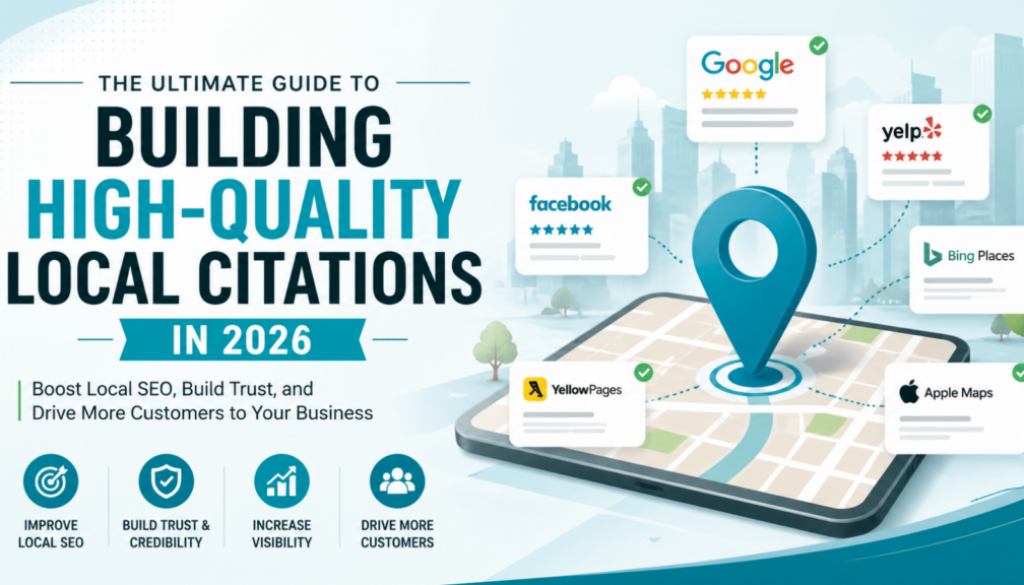
Introduction: The Hidden Power Behind Local Rankings
Ranking locally isn’t just about having a website anymore. In 2026, search engines are more advanced, but they still rely on one foundational signal to verify your business: local citations.
If your business information is inconsistent, incomplete, or missing across the web, your rankings will struggle—no matter how strong your website is.
That’s why local citation building remains one of the most important (and often overlooked) parts of local SEO.
This guide explains everything from the basics to advanced strategies, so you can build citations that improve rankings, visibility, and conversions.
What Are Local Citations in SEO?
Local citations are online mentions of your business details, typically including:
- Business name
- Address
- Phone number (NAP)
They appear on:
- Business directories
- Review platforms
- Social media profiles
- Blogs and news websites
Search engines use these mentions to confirm that your business is legitimate and trustworthy.
Why Local Citations Matter More Than Ever in 2026
Even with evolving algorithms and AI-driven search, citations continue to influence:
- Local pack (map) rankings
- Business credibility
- Customer trust
- Visibility in location-based searches
When combined with Google Business Profile, citations create a consistent signal that strengthens your local authority.
Types of Local Citations (Critical for SEO Success)
Structured Citations
Structured citations are listings found on business directories where your information is clearly organized.
Examples include:
- Directory listings
- Review sites
- Local business platforms
These typically include NAP details, website links, and categories.
Unstructured Citations
Unstructured citations appear naturally across the web, such as:
- Blog mentions
- News articles
- Press coverage
Example: A local news site mentioning your business name and city.
Why This Distinction Matters
Many businesses only focus on directories, but unstructured citations often carry stronger authority signals.
The most effective strategy is to use both.
High-Quality vs Low-Quality Local Citations
High-Quality Citations
- Accurate and consistent NAP
- Relevant to your industry or location
- Hosted on trusted platforms
- Fully optimized listings
Low-Quality Citations
- Duplicate listings
- Inconsistent business information
- Spammy directories
- Incomplete profiles
Quality is always more important than quantity.
How to Build Local Citations Step by Step
Step 1: Claim Core Platforms
Start with major platforms:
- Google Business Profile
- Apple Maps
- Bing Places
These serve as the foundation for your local presence.
Step 2: Ensure NAP Consistency
Your Name, Address, and Phone number must match exactly across all listings. Even small variations can reduce trust signals.
Step 3: Submit to High-Authority Citation Sites
Focus on trusted directories, local listing platforms, and reputable business networks.
Step 4: Expand to Niche Directories
Industry-specific listings improve relevance and credibility. Examples include directories for legal, healthcare, or real estate services.
Step 5: Fully Optimize Each Listing
Enhance every listing by adding:
- Business descriptions
- Images
- Accurate categories
- Website links
Real-World Example: Citation Optimization
Poor Listing
- Missing phone number
- Incorrect address
- No category
Optimized Listing
- Complete and accurate NAP
- Correct business category
- Updated contact details
- Informative description
Small details can significantly impact rankings.
Local Citation Building Checklist
- Claim all major listings
- Maintain NAP consistency
- Remove duplicate listings
- Submit to niche directories
- Optimize every profile
- Monitor and update regularly
How to Audit and Fix Local Citations
Step-by-Step Process
- Search your business name online
- Identify incorrect or duplicate listings
- Update inaccurate information
- Remove duplicates
- Track updates over time
This process improves citation accuracy and strengthens trust signals.
Manual vs Automated Citation Building
Manual Approach
- More accurate
- Higher quality
- Time-intensive
Automated Approach
- Faster
- Scalable
- Risk of inconsistencies
A balanced approach combining both methods is often the most effective.
Advanced Local Citation Strategies for 2026
Competitor Citation Gap Analysis
Identify where competitors are listed and secure those same opportunities.
Data Aggregator Submissions
Submit your business information to aggregators that distribute it across multiple platforms.
Geo-Targeted Listings
Focus on city-specific and region-based directories to improve local relevance.
Building Unstructured Citations
Gain mentions through guest posts, local PR, and community engagement.
Ongoing Citation Management
Citations require regular updates to remain accurate and effective. Treat them as a long-term strategy.
How Many Citations Do You Need?
There is no fixed number. Focus on:
- Competitor benchmarks
- Industry standards
- Quality and relevance
A smaller number of high-quality citations often delivers better results than a large number of low-quality ones.
Common Local Citation Mistakes to Avoid
- Inconsistent NAP information
- Duplicate listings
- Ignoring outdated data
- Submitting to low-quality directories
- Leaving profiles incomplete
How Local Citations Impact Rankings
Citations help search engines:
- Verify your business
- Confirm location relevance
- Build trust
They play a significant role in Google Maps ranking factors and overall local visibility.
Final Thoughts
Local citation building is no longer about volume. It is about accuracy, consistency, and strategic placement.
Businesses that succeed in local SEO focus on maintaining high-quality listings and continuously managing their presence across platforms.
Ready to Strengthen Your Local Presence?
If your listings are inconsistent or incomplete, your rankings are at risk.
Start by auditing your citations, correcting errors, and building high-quality listings. Then scale strategically to improve visibility and generate more leads from local search.

CORPORATE OFFICE
2001 N Lamar Street
Suite Number 270
Dallas, TX 75202