Digital marketing for small businesses in Dallas: what actually works on a limited budget
You don't need to be on every platform, run ads on every network, and post content five times a day. If you're a small business in Dallas with a limited marketing budget, trying to do everything is the fastest way to get nothing from any of it.
The businesses that grow on a tight budget don't spread money across six channels. They pick the two or three things that actually generate calls and leads, do those well, and skip the rest until the revenue justifies expanding.
This guide covers where your marketing dollars should go first, what to avoid, and how to tell when it's time to handle things yourself versus bringing in help. Everything here is built around the reality of running a small business in the DFW area where every dollar has to earn its way back.
What digital marketing means for a small business
Digital marketing is any online activity that puts your business in front of potential customers. For a small business in Dallas, the definition should be narrower than what the textbooks say.
You're not building a national brand. You're trying to be found by people in Dallas, Fort Worth, and surrounding cities who need what you sell and are ready to act. That means showing up in Google when someone searches "plumber near me" or "tax preparer in Plano." It means having a website that makes calling or booking easy. It means appearing in Google Maps with enough reviews to build trust.
The line that matters: activities that generate leads versus activities that look busy. Posting on Instagram three times a day might feel productive, but if none of those posts bring a phone call, it's content creation for its own sake.
Why small businesses waste money on marketing
Most small businesses in Dallas don't fail at marketing because they spend too little. They fail because they spread what they have across too many things that don't connect.
- Trying every channel at once. A little on Facebook ads, a little on Google Ads, a blog post here, a LinkedIn post there. None of it gets enough investment to work, so nothing produces results.
- Boosting random social posts. Hitting "Boost Post" on Facebook without a clear audience, goal, or landing page is the most common way small businesses burn ad money.
- Paying for a website that doesn't convert. A new Dallas bakery spends $5,000 on a beautiful site with no phone number above the fold and no way for a catering lead to request a quote. It looks great. It generates nothing.
- Running ads with no tracking. If you can't tell which ad produced which call, you can't tell what's working. Money disappears into a reporting gap and nobody knows where it went.
- Chasing followers instead of leads. Followers are a vanity metric. A local cleaning company with 47 Instagram followers and a complete Google Business Profile will get more calls than one with 5,000 followers and no GBP listing.
The marketing priorities that matter most on a limited budget
When money is tight, order matters. Do these in sequence. Each one builds on the one before it.
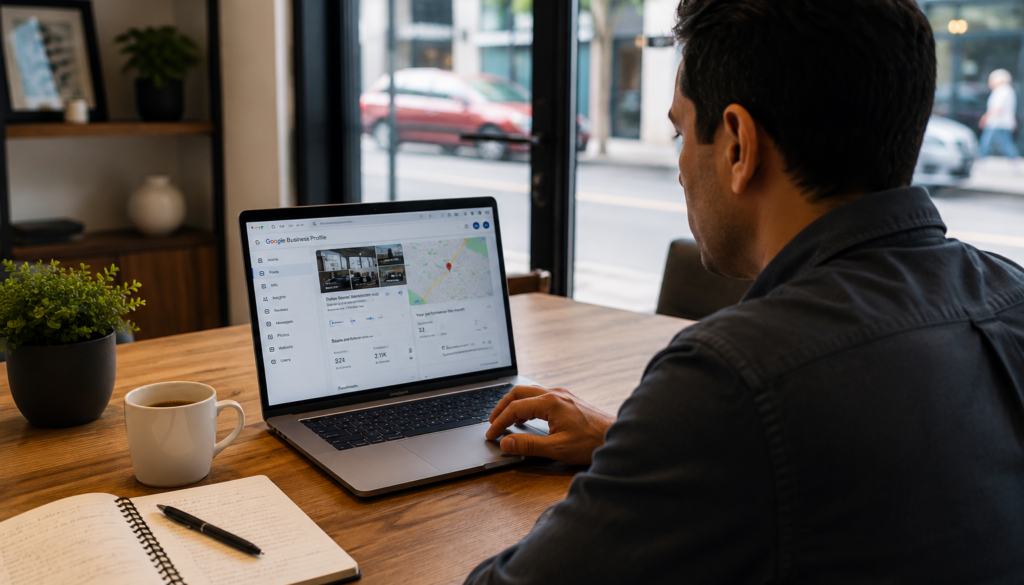
Get your Google Business Profile working
This is free and it's the single highest-impact thing a small business in Dallas can do. A complete, active GBP with accurate categories, services, photos, and reviews shows up in Google Maps and the local pack for searches with buying intent. A Fort Worth dog groomer with a well-maintained GBP will get more calls than one spending $500/month on social media ads with no local search presence.
If your GBP is incomplete or dormant, start there. Our local SEO guide covers the full process.
Fix the website so it converts
There's no point sending traffic to a site that doesn't turn visitors into calls. Before you spend money on ads or SEO, make sure your website loads fast on mobile, has a visible phone number, includes a short contact form, and clearly explains what you do and where you do it.
A $500 fix to your existing site's conversion flow will produce more leads than a $2,000 ad campaign driving traffic to a page that doesn't work. More on what a lead-generating website needs.
Build local SEO before anything paid
Local SEO creates organic visibility that you don't pay for per click. It takes longer to build than paid ads, but the traffic it produces is yours. You're not renting it. A small accounting firm in Dallas that ranks organically for "small business accountant Dallas" gets leads every month without writing a check to Google.
Start with on-page optimization, local content, and citation building. Full breakdown of SEO services and what they include.
Add paid ads once the basics work
Google Ads and Facebook Ads are amplifiers. They work when you send traffic to a website that converts, with tracking that tells you what's producing results. They don't work as a substitute for a broken website or missing local presence.
Once your GBP is active, your website converts, and your SEO foundation is started, paid ads can accelerate results. Not before. Our PPC guide explains how paid advertising fits into the picture.
Keep one social channel active, not five
Pick the platform where your customers actually spend time. For most Dallas service businesses, that's Facebook or Instagram. For B2B, it might be LinkedIn. Post consistently on one channel rather than inconsistently on five. One useful post per week beats five filler posts across three platforms.
How much should a small business spend on marketing?
There's no magic number, but there are useful ways to think about it.
A common guideline is 5% to 10% of revenue, with newer businesses that need to build awareness leaning toward the higher end. But the percentage matters less than where the money goes. Spending 10% of revenue on channels that don't track leads is worse than spending 3% on one channel that does.
A few principles that hold regardless of your budget size:
- Spend on the basics before paid ads. A complete GBP, a website that converts, and basic local SEO cost relatively little and create the foundation that makes everything else work. Skipping these to run ads is like putting gas in a car with no wheels.
- The cheapest option often costs more later. A $300 website built on a free template with no SEO, no tracking, and no conversion focus will need to be rebuilt within a year. The money spent on it and the leads lost during that year add up to more than doing it properly the first time.
- Doing one thing well beats five things poorly. If you only have $1,000 per month, put it into one channel and measure results. Don't split it across Google Ads, Facebook, Instagram, a blog, and an email newsletter. Nothing will get enough fuel to produce anything meaningful.
The real question isn't "how much should I spend?" It's "how much is a new customer worth, and am I spending less than that to get one?"
DIY vs hiring help: when each makes sense
| Factor | DIY | Freelancer | Agency |
|---|---|---|---|
| Monthly cost | Your time only | $500 to $2,000 | $1,500 to $5,000+ |
| Time required from you | High (5 to 15+ hours/week) | Moderate (2 to 4 hours/week) | Low (1 to 2 hours/week) |
| Skills needed | You learn as you go | Depends on the freelancer | Full team across channels |
| Consistency | Hard to maintain when business gets busy | Depends on their availability | Structured and scheduled |
| Results speed | Slow, trial and error | Moderate | Faster, built on experience |
| Best for | Very early stage, tight budget | One specific task or channel | Multiple channels, scaling up |
A very small business can handle a lot of this at the start. GBP setup, asking for reviews, basic social media, and website updates are all manageable when you have more time than money.
The point where hiring help pays off is when your time runs out or results stall. If you're spending 10 hours a week on marketing and not getting leads, the problem is likely strategy, not effort. That's when a freelancer or agency starts making sense.
Simple wins any Dallas small business can start this week
These cost little or nothing and can start producing results quickly:
- Complete your Google Business Profile fully. Every field, every category, every service, real photos.
- Ask your five happiest customers for a Google review this week. Send them a direct link.
- Add a visible phone number and clear call to action to the top of your website on mobile.
- Claim your listings on Yelp, BBB, and your most relevant industry directories.
- Post one useful tip per week on your best social media channel.
- Answer questions in local Dallas and DFW Facebook groups where your customers spend time. Don't pitch. Just be helpful. The reputation builds on its own.
How DFW Website SEO helps small businesses
We work with small businesses across Dallas, Fort Worth, and the DFW area that need to get more from a limited budget. Our approach starts with the free and low-cost basics, Google Business Profile, website conversion fixes, and local SEO, before recommending any paid spend.
We don't sell packages that include channels you don't need. If your Google Business Profile isn't set up properly and your website doesn't convert, we'll fix those before suggesting ads. And if you're at the stage where handling things yourself makes more sense, we'll tell you that too.
Request a free marketing review or call us to schedule a strategy call.

CORPORATE OFFICE
2001 N Lamar Street
Suite Number 270
Dallas, TX 75202