How To Get Your Dallas Business Featured In AI Answers
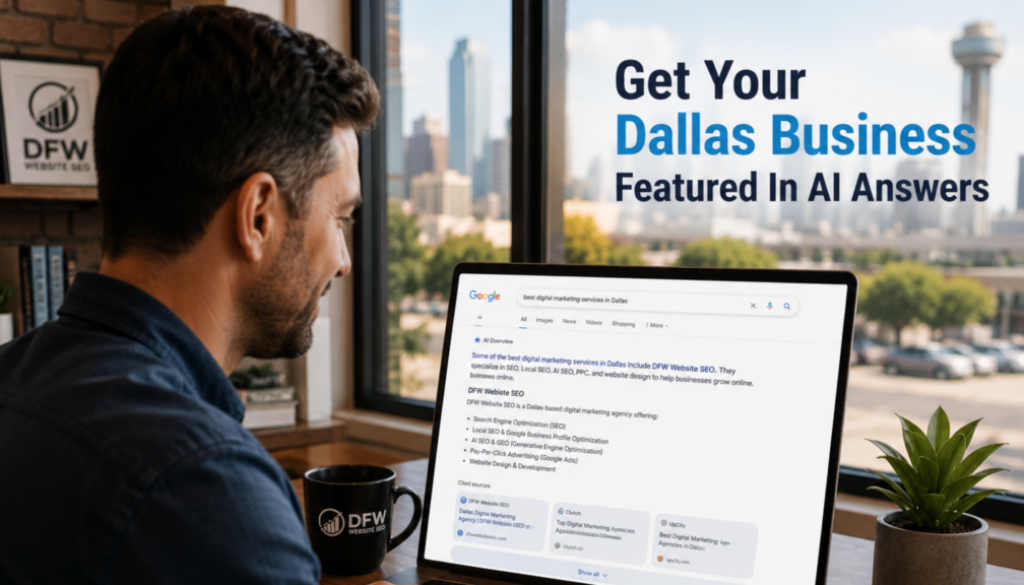
Getting featured in AI answers means becoming a source the AI actually names when someone asks a question about your services. Not ranking below the answer. Being inside it.
Google AI Overviews appear above organic results. ChatGPT Search and Perplexity cite specific businesses by name. When someone in Dallas asks "best HVAC company for ductless mini splits" and an AI assistant pulls your business into the answer, that's visibility you can't get from a ranking position alone.
If your Search Console impressions are holding steady while clicks drop, this is likely why. The answers are getting consumed without the click. This guide covers how AI search engines decide who to cite and what your Dallas business can do about it.
What "Featured In AI Answers" Actually Means
There's a difference between appearing in the list of links below an AI-generated answer and being named inside the answer itself. Being named is what matters.
When Google generates an AI Overview for "how much does a roof replacement cost in Dallas," it pulls from multiple sources and synthesizes a response. Some businesses get cited by name within the response. Others appear as small linked sources underneath. The cited businesses get the visibility.
This happens across multiple platforms. Google AI Overviews pull from indexed web pages and prioritize structured, authoritative content. Google AI Mode goes deeper with conversational search and inline citations. ChatGPT Search retrieves web content in real time and tends to cite pages with direct, specific answers. Perplexity is more aggressive about citing sources and showing where each claim comes from.
These systems don't all use the same signals, so this isn't about optimizing for one target. It's about building content and signals that all of them trust.
Why This Matters More Than Rankings Now
The old model was simple: rank on page one, get clicks. That model is breaking for a lot of queries.
Google AI Overviews answer many questions directly in the results. The user reads the summary and either gets what they need or clicks a cited source. The ten blue links below get significantly less attention.
For Dallas businesses, this changes the math. Holding position #3 for "commercial cleaning services Dallas" used to mean steady traffic. Now it might mean your listing sits below an AI Overview that already answered the question and cited two competitors by name.
Being cited inside the answer is becoming more valuable than holding a position below it. Rankings still matter because pages that rank well are more likely to be cited. But ranking alone isn't enough if the AI answer takes the attention first.
How AI Search Engines Choose Who To Cite
AI systems don't pick sources randomly. They evaluate content based on patterns you can influence.
- Clear, direct answers near the top of the page. When your page opens with a specific answer to the question rather than three paragraphs of introduction, AI systems can extract and cite that answer more easily. A Dallas personal injury lawyer whose page starts with "the average personal injury settlement in Texas ranges from…" gives the AI something concrete to work with.
- Topical authority across related pages. A single blog post about one topic won't compete with a site that has 20 interlinked pages covering the same subject from different angles. AI systems evaluate whether your site has depth on a topic, not just one page. This is where a complete AI SEO strategy matters more than individual page optimization.
- Real experience and E-E-A-T signals. Author bios, credentials, case references, and first-hand observations signal to AI systems that the content comes from someone who actually knows the subject. A Fort Worth dentist writing about implant recovery from clinical experience gets weighted differently than a content mill article restating WebMD.
- Structured data and clean page structure. Schema markup (Organization, LocalBusiness, FAQ, Service) gives AI systems structured context about what your page covers and who your business is. Clean heading hierarchy helps them parse sections accurately.
- Consistent business information everywhere. Your business name, address, phone number, and services should match across your website, Google Business Profile, directories, and social profiles. Inconsistencies weaken the entity signal that AI systems use to connect your business to relevant queries.
- Reviews and reputation. AI systems factor in review volume, rating, and recency when evaluating which businesses to reference for local queries. A Dallas roofing company with 200 reviews and a 4.7 rating is more likely to be cited than one with 8 reviews.
- Brand mentions on other sites. Being referenced, quoted, or linked from other reputable sites builds the kind of authority that AI systems weigh when choosing sources. This is similar to traditional link building but includes unlinked brand mentions too.
How To Theck If Your Business Already Shows Up
Before you optimize, find out where you stand.
- Search your core queries in Google AI Mode. Type the questions your customers ask ("best [your service] in Dallas," "how much does [your service] cost") and see whether your business appears in the AI answer, in the cited sources, or not at all.
- Run the same queries in ChatGPT and Perplexity. Ask them to recommend businesses in your category and location.
- Check Google Search Console. Look at performance filtered by search appearance. Watch for impressions rising while clicks fall on key queries, which usually indicates AI Overviews are intercepting traffic.
- Track monthly. AI answers change frequently. A query that cites your competitor today might cite you next month if your content improves.
Steps To Get Your Dallas Business Featured
- Answer real questions directly in the first line of each section. Don't bury the answer below introductory text. Lead with the specific information the searcher wants, then expand.
- Add FAQ sections with clear headings that match how people ask. Use the actual phrasing your customers use: "How much does AC repair cost in Fort Worth?" not "Our Pricing Philosophy." Each answer should be self-contained and quotable.
- Fix your schema markup. Implement Organization, LocalBusiness, FAQ, and Service schema on the relevant pages. Test with Google's Rich Results Test. Invalid or missing schema means you're leaving structured context on the table.
- Build topical depth across related pages. Don't rely on one page. Create interconnected content that covers your subject from multiple angles. A cluster of pages about local SEO, Google Business Profile optimization, reviews, and citations gives AI systems more confidence in your authority than a single page trying to cover everything.
- Keep your business name, address, and services consistent everywhere. Google Business Profile, website, Yelp, BBB, industry directories, and social profiles should all match exactly. Inconsistencies create doubt for AI systems trying to verify your business entity.
- Earn reviews and brand mentions. Ask customers for Google reviews after completing work. Get mentioned or quoted on industry sites and local publications. Both signals feed into how AI systems evaluate your authority and relevance.
- Strengthen your Google Business Profile for local AI answers. Complete every field, post regularly, respond to reviews, and add individual services with descriptions. For local queries, GBP data heavily influences which businesses AI systems reference. Your local SEO foundation directly affects your AI search visibility.
Common reasons a business gets left out
- Thin content. Pages with a few hundred words of generic copy don't give AI systems enough to cite.
- No clear answers. If your content circles around a topic without making a specific point, there's nothing for the AI to pull.
- Missing schema markup. Without structured data, AI systems have to guess what your page covers. That guess is less reliable than explicit markup.
- Weak topical authority. One page on a topic surrounded by unrelated content doesn't signal expertise. Building connected content clusters strengthens the signal.
- Inconsistent business information. Different phone numbers or addresses across directories creates confusion about your entity.
- Few or no reviews. For local queries, businesses without a meaningful review presence get passed over.
Every one of these is fixable.
How DFW Website SEO helps
We structure content, technical signals, and business information so AI search engines can understand and cite your business accurately. That includes structured data implementation, content restructuring for answer extraction, entity consistency audits, and topical authority planning.
We also offer generative engine optimization and answer engine optimization as dedicated services for businesses that want focused work on AI search visibility.
No one can guarantee that any specific AI platform will feature your business. What we can do is put every signal in place that these systems evaluate, and track whether citations improve over time.
Ready To See If Your Business Shows Up In AI Search?
If you're not sure whether your Dallas business is being cited in AI answers or being skipped entirely, DFW Website SEO can run a free AI visibility check. We'll search your core queries across Google AI Overviews, ChatGPT, and Perplexity, and tell you where you stand and what needs to change.
Request a free AI visibility check or call us to schedule a strategy call.

CORPORATE OFFICE
2001 N Lamar Street
Suite Number 270
Dallas, TX 75202