Why Your Dallas Business Is Missing From The Google Maps 3-Pack (And How To Fix It)
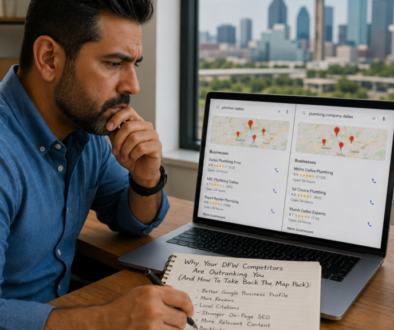
Your phone is quiet while a competitor down the road gets the calls. You’ve both been in business for years. You do better work. But when someone in your area searches for your service, they see three businesses on the map and you’re not one of them.
That’s the Google Maps 3-pack, and for most local searches in Dallas and Fort Worth, those three spots are all that matter. The businesses sitting below them rarely get seen on mobile, and they almost never get called.
Having a Google Business Profile isn’t enough. Thousands of DFW businesses have profiles. The ones in the top three are outperforming the others on specific ranking signals that Google measures and weighs. This guide explains what those signals are, how proximity and “near me” searches actually work, and what you can do to move up.
What The Google Maps 3-Pack Is (And Why Position 4 Is Invisible)
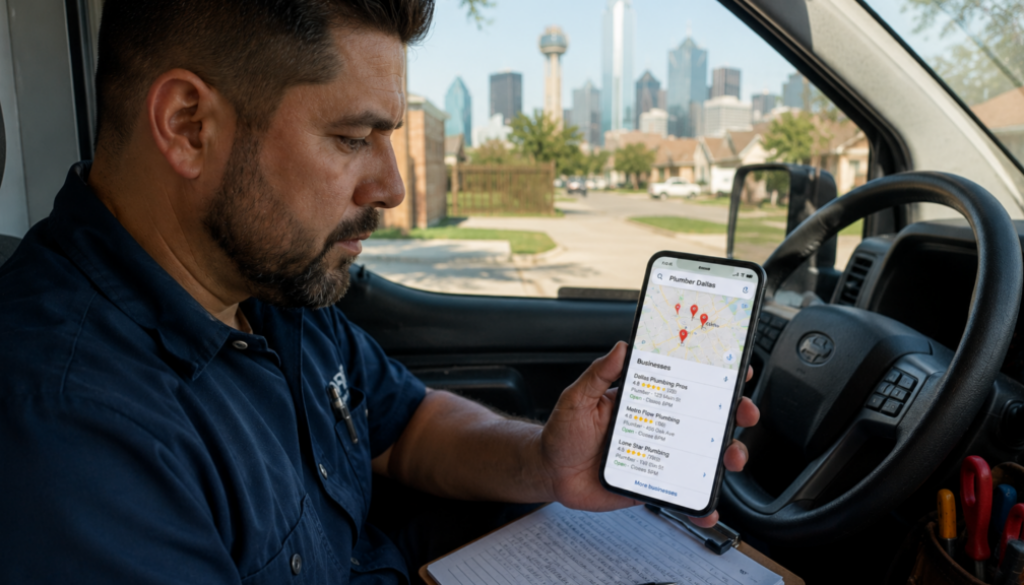
The map pack is the block of three business listings that appears with a map at the top of local search results. When someone in Plano searches “plumber near me,” they see three businesses, a map, and then the regular organic results below.
On a phone screen, the map pack takes up nearly all of the visible area. Positions four and below require extra taps to find. Most people don’t bother. They call one of the three they see first.
This makes Google Maps SEO its own discipline. You can rank well in regular organic search and still sit at position five on the map. A Fort Worth plumber with strong website rankings but a poorly optimized profile regularly loses emergency calls to a closer competitor with a better map presence. Different ranking system, different signals, different results.
The Three Things That Decide Who Ranks: Relevance, Distance, Prominence
Google’s documentation identifies three factors for local map rankings.
Relevance measures how well your profile matches the search. If someone searches “emergency AC repair Dallas” and your profile lists “HVAC Contractor” with emergency repair in your services, you’re relevant. A dentist who picked “Clinic” instead of “Dentist” as a primary category is missing searches because Google doesn’t know what they actually do.
Categories, service descriptions, and your website content all feed relevance.
Distance measures how close you are to the person searching. You can’t move your business, but you can influence how far your reach extends (more in the service-area section below).
Prominence measures how well known and trusted you are. Google evaluates this through review count and quality, links from other sites, consistent business listings, and overall online presence.
These three interact. A business that’s slightly farther away can outrank a closer competitor if its relevance and prominence are stronger. That’s the opening you work with.
If you want help strengthening all three, our team handles this as part of every local SEO engagement.
How “Near Me” And Proximity Really Work
Proximity is the ranking factor you can’t fake but can work around.
When someone searches “plumber near me” from Uptown Dallas, Google shows plumbers near Uptown. If they drive to Richardson and search again, the results change. “Near me” results shift with the searcher’s location, so your map ranking isn’t static.
What you can control is how far your visibility extends. Businesses with strong relevance and prominence show up across a wider radius. A Dallas HVAC company with a complete profile, 150 reviews, and consistent citations might appear for searches 10 miles out. A competitor with a thin profile and 12 reviews might only show up within two miles.
Service-area businesses that travel to customers set a service area instead of showing an address. Google uses that area to determine eligibility, but the same relevance and prominence rules still apply.
Setting Your Service Area To Reach The DFW Suburbs
If you serve customers across Dallas, Fort Worth, Plano, Frisco, Arlington, Irving, and McKinney, your service-area settings determine which of those cities you’re even eligible to appear in.
The mistake a lot of DFW businesses make is setting the area too wide. Claiming the entire metroplex when you realistically serve a 30-mile radius dilutes your signal. Google interprets a massive service area as less locally relevant to any one spot within it. A Frisco roofer who set their service area to all of DFW showed up strongly nowhere because the signal was spread too thin.
The better approach is to set a realistic service area that matches where you actually work, then build local relevance signals for the specific cities within it. That means location-specific content on your website, reviews that mention specific suburbs, and citations on DFW-area directories. These signals tell Google that you’re not just claiming to serve Plano. You actually have a presence there.
The Signals That Move You Up (And Where To Go Deeper)
Several specific optimizations feed into the ranking factors above. Each one has its own spoke in our local SEO content, so here’s where to go deeper rather than repeating what’s already covered:
A complete, well-categorized profile with accurate services and regular posts is the foundation. Our GBP optimization guide walks through every step.
A steady, consistent flow of reviews builds prominence and trust. Our reviews guide covers how to build a system that keeps them coming.
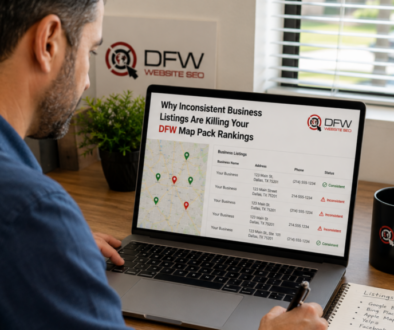
Consistent business information across every directory and listing on the web prevents the signal fragmentation that holds businesses back. Our citations and NAP guide covers how to audit and fix this.
Why Your Business Isn’t Showing On The Map
If you’re completely absent from map results, one of these is likely why:
- Profile not verified. Unverified profiles don’t appear. Complete verification through Google’s process.
- Wrong primary category. “Contractor” instead of “Roofing Contractor” means Google doesn’t know which searches to show you for.
- Too far from the searcher with weak prominence signals. Google won’t stretch to include you.
- Incomplete profile. Missing services, no photos, no posts. Thin profiles are treated as less trustworthy.
- Duplicate or suspended listing. Duplicates split your signals. Suspensions remove you entirely.
- Guideline violation. Most commonly, keywords stuffed into your business name.
Mistakes That Can Get You Suspended
- Stuffing keywords into your business name. If your legal name is “Smith Roofing” but your profile says “Smith Roofing – Best Roofer Dallas TX Emergency Roof Repair,” you’re violating Google’s naming policy. A Dallas law firm that did this lost its listing until the name was corrected and the suspension appealed.
- Using a fake or virtual address. Google requires a real physical address or a legitimate service area.
- Creating multiple listings for the same business. One business, one listing. Extras for coverage or keyword targeting are grounds for suspension.
These aren’t gray areas. Protect the listing your leads depend on.
How AI is Starting To Change Local Discovery
AI answers from Google AI Overviews, ChatGPT, and Perplexity are starting to name specific local businesses when answering local questions. The signals they lean on are familiar: clear business information, reviews, consistency, and content quality. The same work that strengthens your map presence also feeds AI visibility.
For a full look at how this works, see our AI local SEO guide.
The Dallas Google Maps checklist
Five things to get right, in order:
- Claim and verify your profile with accurate DFW business details
- Pick the most specific primary category, not the broadest
- Keep reviews coming in steadily and respond to every one
- Keep your name, address, and phone identical everywhere
- Check your map ranking regularly and adjust as competitors move
How DFW Website SEO Helps
We help DFW businesses strengthen the relevance, prominence, and consistency signals that move them up the map. That’s ongoing work: monitoring rankings across Dallas zip codes, adjusting as competitors shift, maintaining review flow, and keeping citations clean.
We’ve done this for over 1,000 businesses across 13 years in the DFW market. One of our Dallas retail clients grew their business 5x with a local SEO strategy anchored in map visibility.
We don’t guarantee a specific map position. We build the signals that earn one.
Ready for a map visibility check?
If you’re not sure why your DFW business isn’t in the top three on the map, we can find out. DFW Website SEO offers a free Google Maps visibility check that shows where you rank across Dallas zip codes and what’s holding you back.
Request a free Maps visibility check or call us to talk through your situation.

CORPORATE OFFICE
2001 N Lamar Street
Suite Number 270
Dallas, TX 75202