How Your Online Reputation Affects Local SEO, Google Ads, And AI Search in Dallas
Your reviews and online reputation now influence three things at once: where you rank in local search, how well your ads convert, and whether AI tools like ChatGPT and Google AI Overviews trust your business enough to recommend it.
Most Dallas business owners think of reputation as a customer service issue. It is. But it’s also a search visibility issue, an ad performance issue, and an AI trust issue. One asset feeds three channels, and ignoring it weakens all of them.
This guide breaks down how reputation affects each channel and what you can do to build one that helps rather than hurts.
What “Online Reputation” Means For Search
Online reputation is how your business looks to someone who searches for you or finds you through search results. That includes your Google review rating and volume, how (or whether) you respond to reviews, what people say about you on other platforms, and how consistently your business information appears across the web.
Search engines and AI systems read all of this as a trust signal. A Dallas HVAC company with 180 reviews, a 4.8 rating, and thoughtful responses to every review looks different to Google and ChatGPT than one with 9 reviews and no responses. The algorithms don’t read the words the way a person does, but they measure the patterns: volume, recency, sentiment, and engagement.
How Reputation Affects Local SEO
Google has confirmed that reviews are a ranking factor for local results. Review count, rating, and recency all influence where your business shows up in the local pack and map results.
But it goes beyond rankings. A business with a strong review profile also earns more clicks from the local pack because users scan ratings before tapping. Two businesses in the same three-pack with the same proximity to the searcher won’t get equal attention. The one with 200 reviews and 4.7 stars will get picked over the one with 15 reviews and 4.2 stars almost every time.
Review responses matter too. Google’s own documentation encourages businesses to respond to reviews, and activity on your profile signals engagement. A Dallas dentist who responds to every review, positive and negative, with something specific to the patient’s experience sends a stronger signal than one who never responds.
For a deeper look at how local SEO works, see our local SEO guide.
How Reputation Affects Your Google Ads
Your reputation influences paid advertising in two ways: ad appeal and conversion rate.
Google can display seller ratings as star ratings alongside your search ads. These ratings are aggregated from review sources and only appear when you meet certain thresholds. Ads with visible ratings tend to earn higher click-through rates because the stars stand out visually.
The bigger impact is on conversion. When someone clicks your ad and lands on your site, they often check your reviews before contacting you. A strong review profile lowers the barrier between click and conversion. A weak one raises it. Two Dallas law firms running the same ad spend with the same keywords can see very different cost-per-lead numbers based purely on what the searcher finds when they look up reviews.
This is where reputation and PPC management connect. Paid ads drive traffic, but reputation determines how much of that traffic turns into leads.
How Reputation Affects AI Search
AI search tools like Google AI Overviews, ChatGPT, and Perplexity evaluate trust when choosing which businesses to cite. Reviews and reputation are a core part of that evaluation.
When someone asks an AI “best family dentist in Dallas,” the system doesn’t just look at which websites rank. It evaluates which businesses have the strongest trust signals: review volume, quality, recency, consistent brand mentions, and E-E-A-T indicators. A dental practice with 300 reviews, a 4.9 rating, and active engagement across its profiles is more likely to be named than one with a thin review presence regardless of website quality.
Reputation also feeds the brand authority signals that AI systems use to decide which sources to trust. A business that’s well-reviewed, frequently mentioned, and consistently represented across the web builds an entity profile that AI treats as reliable.
For more on how AI systems choose who to cite, see our AI SEO checklist.
How To Build A Reputation That Helps All Three
- Ask happy customers for reviews after every job. Send a direct link to your Google review page by text or email within 24 hours of completing the work. The businesses that get reviews consistently aren’t the ones with the best service alone. They’re the ones that ask.
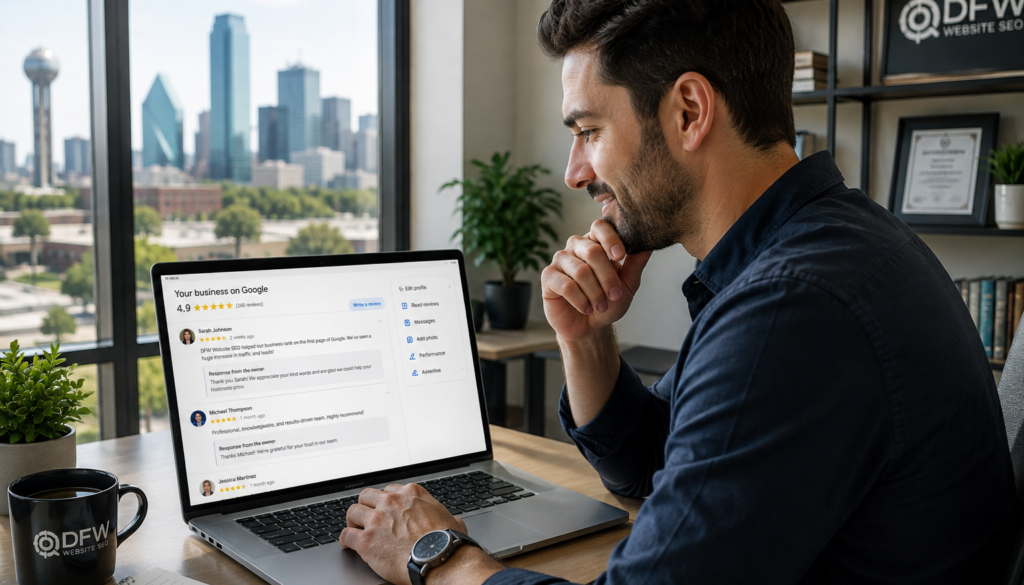
- Respond to every review. Thank positive reviewers with something specific. Address negative reviews calmly and professionally. Never argue, never get defensive. A thoughtful response to a negative review builds more trust than the review itself costs.
- Keep your business information consistent everywhere. Your name, address, phone number, and service descriptions should match across your website, GBP, directories, and social profiles. Inconsistencies weaken trust signals for all three channels.
- Fix negative patterns instead of ignoring them. If multiple reviews mention the same problem (slow response times, unclear pricing, difficult scheduling), fix the underlying issue. Reputation management isn’t about suppressing bad reviews. It’s about eliminating the reasons they happen.
- Stay active on your profiles. Post on your GBP weekly. Keep your social profiles current. Update photos and service descriptions. Dormant profiles signal a dormant business, and both search algorithms and AI systems notice.
- Monitor your reputation regularly. Set up Google Alerts for your business name. Check your Google review profile monthly. Watch for new listings or mentions you haven’t responded to.
Common Reputation Mistakes
- Ignoring reviews entirely. No responses, no strategy, no awareness of what’s being said. This is the most common mistake and the easiest to fix.
- Buying fake reviews. Google detects and removes them. Getting caught can result in your GBP being suspended. The short-term gain isn’t worth the risk.
- Inconsistent business information. Old phone numbers and outdated addresses on directories you forgot about. Run a citation audit at least once a year.
- No review system. Relying on customers to leave reviews without asking is not a strategy. The businesses with strong review profiles built them intentionally.
- Arguing with negative reviewers. A defensive response does more damage than the review itself. Readers judge your response more than the complaint.
How DFW Website SEO helps
We help Dallas businesses build and manage a reputation that supports local SEO, ad performance, and AI visibility together. That includes review strategy, citation management, GBP optimization, and monitoring.
If you have a reputation management need, we offer that as a service alongside our SEO and advertising work. The value is that your reputation, search visibility, and paid campaigns all get managed as one connected system rather than in isolation.
Ready For A Reputation Check?
If you’re not sure how your online reputation is affecting your search visibility, ad performance, and AI citations, DFW Website SEO can run a free reputation and visibility review. We’ll assess your reviews, citations, and business signals across all three channels.
Request a free reputation review or call us to schedule a strategy call.

CORPORATE OFFICE
2001 N Lamar Street
Suite Number 270
Dallas, TX 75202