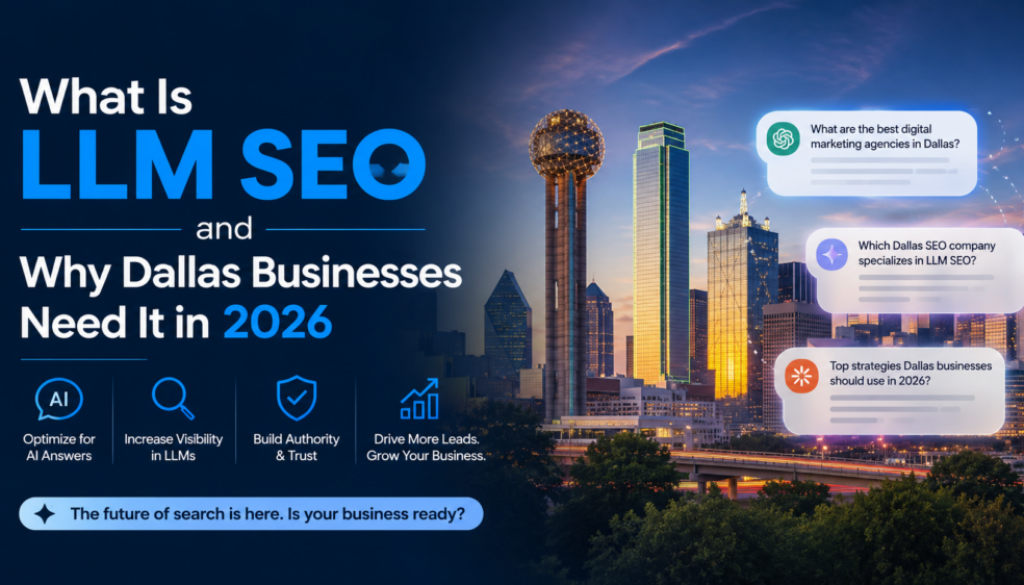
What Is LLM SEO and Why Dallas Businesses Need It in 2026
Let me ask you something. When was the last time you typed something into Google and actually clicked through five different websites before making a decision?
If you’re honest, the answer is probably “not recently.” These days, more people are skipping the list of blue links entirely and just asking an AI. They type a question into ChatGPT, Google Gemini, Perplexity, or Microsoft Copilot — and they get a direct answer. One source. No clicking required.
That shift sounds small. It isn’t. For Dallas businesses that depend on online visibility to bring in customers, this changes the game in a way most business owners haven’t caught up with yet.
That’s what LLM SEO is all about. And if you haven’t heard of it, this is a good time to start paying attention.
What Does LLM Actually Stand For?
LLM stands for Large Language Model. It’s the technology behind AI tools like ChatGPT, Gemini, Claude, and Perplexity. These systems are trained on enormous amounts of text from across the internet, and they use that training to generate responses to questions in natural, conversational language.
When someone asks ChatGPT “what’s the best HVAC company in Dallas?” or “who does reliable SEO for small businesses in the DFW area?” — an LLM pulls together everything it knows from the web and generates an answer. It might mention a few businesses by name. It might describe what to look for. It might give a confident recommendation.
The businesses it mentions are the ones it has learned to trust. The ones it doesn’t mention might as well not exist — at least for that user, in that moment.
LLM SEO is the work of making your business one of the ones that gets mentioned.
It’s different from traditional Google SEO in some important ways, but it’s not a replacement. Think of it as an additional layer — optimising not just for Google’s algorithm but for how AI models read, understand, and cite your brand.
How AI Models Decide Who to Cite
Here’s where it gets interesting — and where most businesses get it wrong.
LLMs don’t rank pages the way Google does. They don’t look at backlink counts or keyword density and produce a top-10 list. They’ve been trained on the web, and they’ve built a model of which sources, which brands, and which types of content are reliable and worth referencing. By the time someone asks a question, a lot of that trust has already been established.
The signals that build that trust include: whether your content actually answers questions clearly and completely, whether other websites reference or cite your brand, whether your structured data is clean and organised, whether your business information is consistent across the web, and whether you’re recognised as an authority in your specific niche or geographic area.
A business can have a perfectly ranked Google page and still get zero mentions from ChatGPT or Gemini. That’s because Google’s algorithm and an LLM’s citation model are measuring different things. One is looking at technical signals. The other is essentially asking: “Would I feel comfortable citing this brand as the answer to someone’s question?”
“If your content isn’t optimised for AI systems, you can become invisible — not just harder to find, but genuinely absent from the conversation.”
For Dallas businesses — roofing companies, law firms, dentists, real estate agents, IT service providers, restaurants, contractors — this matters. People in DFW are using AI to find local service providers. The question is whether they’re finding you or your competitor.
Traditional SEO vs LLM SEO — What’s Actually Different?
You don’t need to throw out everything you know about SEO. The fundamentals — high-quality content, technical site health, authority signals — still matter in both worlds. But the emphasis shifts in a few important ways.
| Factor | Traditional SEO | LLM SEO |
|---|---|---|
| Primary goal | Rank on Google’s results page | Get cited in AI-generated answers |
| Keyword focus | Exact-match short-tail keywords | Conversational, question-based queries |
| Content style | Keyword density, header structure | Clear, complete answers that resolve questions |
| Authority signals | Backlinks, domain authority | Citations, entity recognition, structured data |
| Technical needs | Page speed, crawlability, indexing | Schema markup, entity consistency, clean data |
| Local signals | Google Business Profile, NAP, local links | Geographic entity signals, GEO optimisation |
| Timeline | 3–6 months typically | Variable — authority builds cumulatively |
Notice that last row — “geographic entity signals” and GEO optimisation. If you haven’t come across that term yet, Generative Engine Optimisation (GEO) is closely related to LLM SEO and focuses specifically on getting your brand featured in AI-generated search results at a local level. For Dallas businesses, it’s worth understanding both together.
Why Dallas Businesses Are Particularly Exposed Right Now
Dallas is a competitive market. There are a lot of businesses across DFW competing for the same customers — in roofing, legal services, healthcare, home improvement, financial services, and dozens of other sectors.
In traditional SEO, competing in a city like Dallas means investing heavily over time to build authority. That’s expensive and slow. In LLM SEO, the window to establish first-mover advantage is still open — but not for long.
Most Dallas businesses right now are not optimised for AI-driven search. Their content was written for Google. Their structured data is incomplete or inconsistent. Their brand signals are scattered. An LLM reading their website comes away uncertain about what they do, who they serve, and whether they’re trustworthy enough to recommend.
That’s the gap. And the businesses that close it now will hold a real advantage as AI search continues to grow.
Think about it from a customer’s perspective. Someone moves to Dallas and needs a plumber they can trust. They ask ChatGPT. The AI mentions two or three local companies — confidently, by name, with a brief description. One of them is your competitor. You’re not mentioned. That potential customer is probably going to call one of the businesses the AI recommended.
You didn’t lose that customer because your service is worse. You lost them because your online presence isn’t built for how they searched.
Signs Your Dallas Business Isn’t Ready for LLM Search
- Your content answers very few questions directly — it mostly describes what you do
- You don’t have schema markup or your schema is incomplete
- Your business name, address, and phone number vary across your website and directories
- You have no FAQ content, blog, or Q&A sections on service pages
- AI tools like ChatGPT don’t mention your business when asked about your service category in Dallas
What LLM SEO Work Actually Looks Like in Practice
Let’s get specific, because this is where things get muddied. “AI SEO” and “LLM SEO” get thrown around a lot without much clarity on what the work actually involves.
At a practical level, working with an LLM SEO agency covers several interconnected areas:
Content restructured for AI comprehension
Your existing content probably wasn’t written with LLMs in mind. Most business websites have service pages that describe offerings in vague, promotional language. LLMs struggle to extract useful information from that kind of writing. The work involves rewriting and restructuring content so an AI model can clearly identify: what your business does, who it serves, where it operates, and why it’s trustworthy.
Conversational keyword targeting
People don’t talk to AI the way they used to type into Google. They ask full questions: “What’s the best way to find a trustworthy roofer in Plano?” or “How much does commercial landscaping cost in Dallas?” Your content needs to anticipate and answer those questions directly, not just pepper in a few keyword phrases and hope for the best.
Schema markup and entity optimisation
Structured data tells AI systems exactly what your business is, where it operates, what it does, and how to categorise it. Without clean schema — LocalBusiness, Service, FAQ, AggregateRating — you’re leaving it up to the AI to guess. It often guesses wrong, or simply skips you.
Authority and citation building
LLMs learn from the web. If your brand is mentioned, cited, and referenced by other trusted sources — industry publications, local directories, news sites, partner businesses — that builds the kind of external signal that AI models use to determine whether your brand is worth recommending. This is different from traditional link building but uses some of the same thinking.
Technical SEO foundations
None of the above works well if your site is slow, poorly organised, or has technical errors that prevent proper crawling. The AI-powered SEO services that support LLM optimisation always start with the technical foundation — making sure the site is clean, fast, and fully readable by both Google and AI systems.
“Most Dallas businesses are competing hard for Google rankings while their competitors quietly start showing up in the AI answers their customers are actually reading.”
The Connection Between LLM SEO and Local Search
One thing worth addressing directly: LLM SEO is not just for national brands or tech companies. The local angle is actually where it matters most for most Dallas businesses.
When someone in Frisco asks an AI for a recommended orthodontist, or someone in Oak Cliff asks for a reliable electrician, the AI has to decide which local businesses it knows well enough to recommend. That decision is based on what it has learned from the web — and local businesses that have invested in structured local signals, consistent NAP data, and geographically relevant content have a clear advantage.
Research from Search Engine Land has confirmed that AI Overviews in Google are increasingly drawing from local business information — with structured data, Google Business Profile completeness, and citation consistency all playing a role in which businesses get mentioned.
This is why NAP consistency — having the same business name, address, and phone number everywhere — isn’t just a traditional local SEO checkbox. It’s an entity signal that AI systems use to build their understanding of your business. Inconsistent data means an uncertain AI model. An uncertain AI model doesn’t recommend you.
How Long Does LLM SEO Take to Show Results?
Honest answer: it varies. Some businesses see their content getting cited in AI responses within a few weeks of targeted optimisation, especially in markets or niches where the competition hasn’t started yet. Others, particularly in crowded categories in competitive Dallas submarkets, might take three to six months of consistent work before they see meaningful citation frequency.
What speeds things up is starting with strong technical foundations, having content that genuinely answers real questions, and building external brand signals steadily over time. What slows it down is trying to shortcut it — stuffing keywords into content, using thin pages, or ignoring the structured data layer entirely.
The other factor worth noting: LLM SEO gains compound. Every piece of well-optimised, AI-friendly content you publish adds to your brand’s citation history. The more often AI models encounter your brand as a reliable source, the more they trust it going forward. Starting now — even if you only do it right for six months — puts you ahead of competitors who don’t start until 2027.
What the Research Actually Says About AI Search Growth
This isn’t a trend that’s still developing in a lab somewhere. It’s already happening at scale.
According to Statista, the number of monthly active users across major AI search platforms more than doubled between 2023 and 2025, with ChatGPT alone crossing 200 million weekly active users by late 2024. Google has integrated AI Overviews across virtually all search result pages in the US. Perplexity has grown from a niche tool to a go-to research assistant for professionals and consumers alike.
The people using these tools aren’t just tech enthusiasts. They’re homeowners in Plano looking for a contractor, business owners in Irving researching marketing agencies, and parents in Allen looking for a pediatric dentist. They’re exactly the customers Dallas businesses want to reach.
The question is whether your business shows up when they ask.
Is Your Dallas Business Showing Up in AI Search?
DFW Website SEO offers a free consultation to check how your brand currently appears in AI-driven answers — and where the gaps are. No pressure, just a clear picture of where you stand.
Get Your Free LLM SEO Consultation →
Where to Start If You’re Behind
If you’ve read this far and you’re fairly confident your Dallas business isn’t well-positioned for LLM search, here’s a practical starting point.
First, do the test mentioned above. Ask ChatGPT about your category and location. You’ll know immediately whether you’re visible or invisible in AI-driven answers. That context makes everything else more concrete.
Second, check your structured data. Go to Google’s Rich Results Test and run your homepage and your main service pages. Look for errors, missing fields, or warnings. Schema issues are often the quickest technical fix and one of the most direct ways to improve AI readability.
Third, look at your content honestly. Does it answer questions, or does it just describe what you do? A service page that says “We provide excellent roofing services in Dallas with 20 years of experience” tells an AI model almost nothing useful. A page that explains what roofing problems Dallas homeowners commonly face, what to look for in a contractor, what the process looks like, and what a fair price range is — that page is useful. AI models prefer useful.
Fourth, check your NAP consistency. Search your business name on Google. Click through to five or six different directory listings. Make sure your name, address, and phone number are identical everywhere. Even small variations — “Suite 100” vs “Ste. 100” — can introduce entity confusion.
None of these steps require a huge budget. They require attention and consistency. And they’re the foundation of everything else that follows.
The Bottom Line
LLM SEO isn’t a buzzword. It’s a response to a real shift in how people find businesses and make decisions. In Dallas — a city with a competitive market across almost every service category — the businesses that understand this shift early will hold an advantage that gets harder to close over time.
Traditional Google SEO is still worth investing in. But if your digital strategy doesn’t account for AI-driven search, you’re optimising for a shrinking slice of how your customers actually find you.
The window to get ahead of this in the DFW market is still open. It won’t be forever.

CORPORATE OFFICE
2001 N Lamar Street
Suite Number 270
Dallas, TX 75202