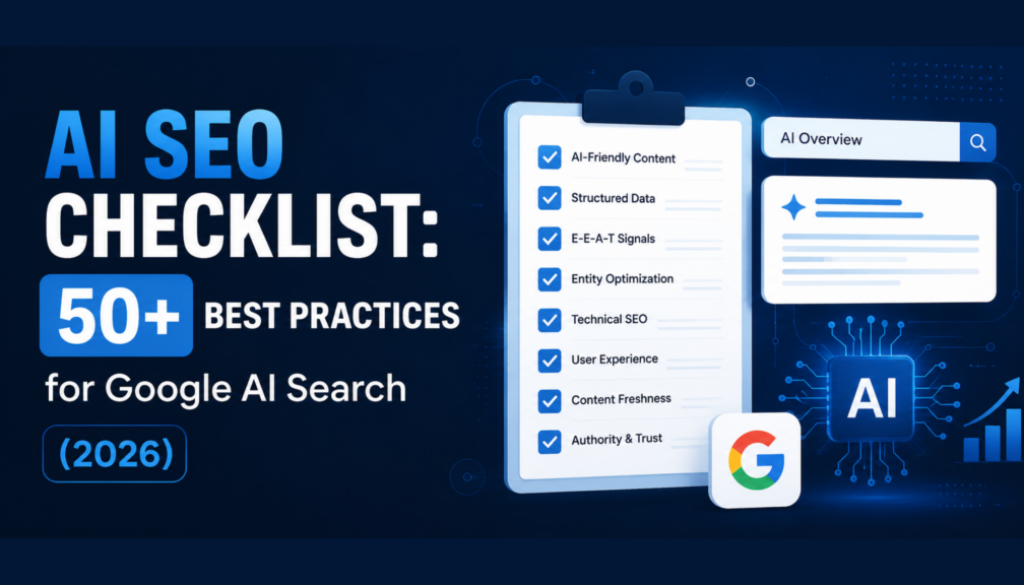
AI SEO Checklist: 50+ Best Practices for Google AI Search (2026)
A year ago, ranking on the first page of Google was enough to generate steady leads. Today, that’s changing. Google AI Overviews, ChatGPT, Gemini, and Perplexity are answering questions before users even click a website. If your business isn’t part of those answers, you’re losing visibility, traffic, and potential customers to competitors who are.
For businesses in Dallas, Fort Worth, and across the DFW metroplex, this shift has real financial consequences. A roofing company that used to rank in the top three organic results might now sit below an AI Overview that pulls content from a competitor’s better-structured page. A law firm’s blog post might get bypassed entirely because it doesn’t answer the question quickly enough for an AI assistant to quote.
This checklist covers the specific steps your business needs to take, organized by category, with explanations you can actually use.
What is an AI SEO checklist?
An AI SEO checklist is a structured set of optimization tasks designed to improve your website’s visibility in AI-powered search results, including Google AI Overviews, ChatGPT retrieval, Gemini, Perplexity, and Microsoft Copilot.
Traditional SEO checklists focused on keyword placement, meta tags, and backlinks. Those things still matter. But AI search systems evaluate content differently. They look for entity connections, structured data, direct answers, topical depth, and trust signals that go beyond what a standard SEO audit covers.
An AI SEO checklist combines technical SEO, content structure, entity optimization, and authority signals into one framework. The goal is to make your website a source that AI systems want to reference when generating answers.
| Traditional SEO checklist | AI SEO checklist |
|---|---|
| Keyword density | Semantic coverage and entity optimization |
| Meta tags | Structured data and schema markup |
| Backlink count | Source authority and E-E-A-T signals |
| Page speed | Core Web Vitals plus crawl efficiency |
| Content length | Answer quality and topical completeness |
| Rankings for keywords | Cited in AI-generated answers |
Why AI SEO matters for Dallas businesses
Most local business owners in the DFW area haven’t adjusted their SEO strategy for AI search. Honestly, most don’t even know they need to. That creates a real opportunity for the ones who pay attention.
Consider a Fort Worth dental practice that publishes a page about Invisalign. If the page opens with a paragraph of generic marketing copy and buries the actual treatment details below the fold, Google’s AI Overview will pull its answer from a competitor who leads with clear, specific information. The dental practice still “has” a page about Invisalign. It just doesn’t get referenced.
The same pattern shows up across industries. A Dallas HVAC company that publishes detailed content about AC repair costs, what usually causes units to fail, and when it makes sense to replace rather than repair will get cited more often than a competitor whose page just says “Call us for AC repair.”
When you optimize for AI search, a few things change:
- Your content gets pulled into Google AI Overviews, which appear above traditional organic results
- AI assistants like ChatGPT and Gemini reference your business when users ask questions related to your services
- Your website builds topical authority that strengthens regular organic rankings too
- You attract visitors who are further along in the decision-making process because the AI already validated your expertise
AI SEO isn’t a separate strategy from regular SEO. It builds on top of it. But the businesses that adjust first will have a real edge over those that wait.
How Google AI Search and AI assistants rank content
Understanding how these systems select content helps you see why each checklist item below matters.
Google’s AI Overviews pull from indexed web pages, but they prioritize content that:
- Directly answers the user’s question within the first few sentences
- Uses structured data to clarify what the page is about
- Comes from sources with established authority in that topic area
- Covers the subject comprehensively without unnecessary padding
- Connects to related entities and concepts that confirm topical relevance
ChatGPT, Gemini, and Perplexity work somewhat differently. They use retrieval-augmented generation (RAG), which means they search the web, pull relevant passages, and synthesize an answer. Your content is more likely to be retrieved if:
- It is clearly structured with descriptive headings
- It provides specific, quotable answers
- It includes data points, comparisons, or step-by-step breakdowns
- It demonstrates expertise through original analysis rather than restated generic advice
Microsoft Copilot relies on Bing’s index, so standard Bing SEO factors like page structure, schema markup, and content freshness affect visibility there too.
All of them favor well-organized content from sources that clearly know what they’re talking about.
50+ AI SEO checklist items
Technical SEO foundations
1. Run a full crawl audit
Use Screaming Frog, Sitebulb, or a similar crawler to identify broken links, redirect chains, orphaned pages, and crawl errors. AI search systems rely on clean site architecture to discover and evaluate your content. A site with hundreds of crawl errors sends a signal that the content may not be reliable.
2. Implement clean, logical URL structures
URLs should follow a consistent pattern that reflects your site hierarchy. A Dallas remodeling company should have /services/kitchen-remodeling/ rather than /page-id-3847/. Clean URLs help both crawlers and AI systems understand what the page covers before they even process the content.
3. Optimize Core Web Vitals
Largest Contentful Paint, Interaction to Next Paint, and Cumulative Layout Shift affect how Google evaluates your pages. Sites that load slowly or shift around as they render are less likely to be cited in AI Overviews. Check your performance in Google Search Console under the Core Web Vitals report.
4. Fix your robots.txt and sitemap
Make sure your robots.txt isn’t blocking pages you want indexed. Your XML sitemap should include all important pages and exclude thin or duplicate content. Update it whenever you add new pages. This sounds basic, but we see Dallas business websites with outdated sitemaps all the time.
5. Use HTTPS everywhere
Every page should load over HTTPS. Mixed content warnings or insecure pages reduce trust signals that AI systems factor into their evaluations.
6. Optimize for mobile-first indexing
Google indexes the mobile version of your site first. If your mobile experience is poor (tiny text, elements too close together, slow load times), it affects your performance in both regular search and AI search. Test with Google’s mobile-friendly test and PageSpeed Insights.
7. Implement canonical tags correctly
If you have pages with similar or identical content, canonical tags tell search engines which version to treat as the primary one. Incorrect canonicalization can split your authority across multiple URLs and weaken your chances of being cited.
8. Enable server-side rendering for JavaScript-heavy sites
If your website relies heavily on JavaScript to render content, search engine crawlers might not see all of it. Server-side rendering or prerendering ensures that crawlers (and AI retrieval systems) can access your full content.
Content optimization
9. Answer the primary question in the first 100 words
AI systems scan for direct answers near the top of a page. If someone searches “how much does a new roof cost in Dallas,” and your page starts with three paragraphs about your company history before mentioning pricing, an AI system will pull the answer from a competitor who leads with the information.
10. Write concise definitions before expanding
When you introduce a concept, give a clear one to two sentence definition first. Then expand with details, examples, and context. This pattern matches how AI systems extract “quotable” passages for generated answers.
11. Use descriptive, specific headings
“Our Services” tells an AI system nothing. “AI SEO services in Dallas” tells it exactly what the section covers. Descriptive headings act as labels that help AI systems navigate your content and match it to user queries.
12. Cover topics comprehensively
Thin content doesn’t get cited. If you’re writing about commercial HVAC maintenance in Fort Worth, cover what maintenance includes, how often it should happen, common issues it prevents, cost ranges, and how to choose a provider. Topical completeness is one of the strongest signals for AI citation.
13. Include original analysis and insights
Generic advice that could appear on any website won’t earn citations. A Dallas financial advisor who shares specific observations about tax planning strategies for Texas business owners provides more value than one who restates IRS guidelines. Original perspective is what separates content that gets cited from content that gets ignored.
14. Use comparison tables
Tables are highly structured, easy for AI systems to parse, and frequently pulled into AI Overviews. Compare pricing, features, service options, or pros and cons in table format wherever it makes sense.
15. Create content for every stage of the buyer journey
Don’t only write about your services. Write about the problems your customers face before they know they need you. A Dallas plumber should have content about “why is my water bill so high” and “signs of a slab leak” in addition to service pages. These informational queries are exactly what AI assistants answer.
16. Write for readability
Short paragraphs. Clear sentences. No jargon unless you define it. Content that is easy to read is also easy for AI systems to process and extract from. Aim for a reading level that a smart business owner can follow without specialized knowledge.
17. Update existing content regularly
AI systems prefer fresh, accurate information. Review your top-performing pages quarterly. Update statistics, add new sections, and remove outdated references. A page last updated in 2023 is less likely to be cited than one refreshed in 2026.
AI search optimization
18. Optimize for Google AI Overviews specifically
Look at the AI Overviews appearing for your target keywords. What format are they using? Lists? Paragraphs? Tables? Structure your content to match that format. If the AI Overview for “best roofing materials for Dallas weather” shows a comparison list, make sure your page includes one.
19. Write “quotable” paragraphs
AI assistants pull specific passages from web pages. Write self-contained paragraphs that make sense on their own without requiring context from surrounding text. Each paragraph should make a clear, specific point.
20. Answer “People Also Ask” questions within your content
Google’s People Also Ask boxes reveal the follow-up questions users have about your topic. Include those questions (or close variations) as H2 or H3 headings in your content, and answer them directly. This increases the chances that AI systems cite your page for multiple related queries.
21. Optimize for voice search
Voice queries tend to be longer and more conversational. Include natural-language questions and answers throughout your content. “What does a home inspection cost in Fort Worth?” is the kind of query voice assistants receive, and your content should answer it clearly.
22. Structure content for featured snippets
Featured snippets still appear alongside and within AI Overviews. Format your content with numbered lists, bullet points, definition paragraphs, and tables that Google can extract directly.
23. Build content clusters around core topics
A single page about “SEO” won’t compete. But a cluster of connected pages covering technical SEO, local SEO, keyword research, link building, content strategy, and SEO audits, all interlinked, creates a topical footprint that AI systems recognize as authoritative.
Entity SEO and knowledge graph optimization
24. Identify and optimize for relevant entities
Entities are the people, places, organizations, concepts, and things that Google’s Knowledge Graph tracks. When you write about “AC repair in Dallas,” the entities include the service type (HVAC repair), location (Dallas, Texas), and potentially your business. Mention related entities naturally throughout your content to strengthen topical connections.
25. Create and maintain a Google Business Profile
For local businesses, your Google Business Profile is one of the strongest entity signals. Keep it updated with accurate business information, service categories, photos, posts, and respond to reviews. This feeds directly into how AI search understands your business.
26. Build entity connections across platforms
Your business should appear consistently on your website, Google Business Profile, social media profiles, industry directories, and review sites. Consistent Name, Address, and Phone number (NAP) information across these platforms strengthens your entity identity.
27. Reference known entities in your content
When you mention tools, locations, organizations, or concepts that Google already tracks, you strengthen the semantic context of your page. A Dallas digital marketing agency writing about SEO should reference Google Search Console, Google Analytics, and Schema.org rather than vaguely referencing “analytics tools.”
Structured data and schema markup
28. Implement Organization schema
This tells search engines who you are, where you’re located, your contact information, and your social profiles. It is the foundation of your structured data.
29. Add LocalBusiness schema
For businesses serving Dallas, Fort Worth, or specific DFW cities, LocalBusiness schema helps AI systems connect your business to local search queries. Include your service area, address, hours, and accepted payment methods.
30. Use FAQ schema on relevant pages
FAQ schema can generate rich results in Google Search and provides structured question-answer pairs that AI systems reference directly. Add it to service pages and blog posts that include FAQ sections.
31. Implement Article schema on blog posts
Article schema helps search engines understand the author, publication date, topic, and structure of your content. This is especially relevant for AI systems evaluating E-E-A-T signals.
32. Add Service schema to service pages
Service schema specifies what your business offers, who it’s for, and the service area. A Dallas web design company should have service schema on every service page, from WordPress development to ecommerce SEO.
33. Use HowTo schema for process content
If your content explains a process (how to prepare for a roof inspection, how to choose a PPC agency), HowTo schema structures that information for AI retrieval.
34. Test structured data regularly
Use Google’s Rich Results Test and Schema Markup Validator to confirm your structured data is valid and generating the expected results. Broken or invalid schema provides no benefit.
E-E-A-T optimization
35. Publish author information on every content page
Google’s quality guidelines emphasize knowing who created the content. Add author bios with relevant credentials and experience. A blog post about local SEO strategies should show that the author has actual experience with local SEO campaigns.
36. Create a detailed About page
Your About page should establish your company’s expertise, experience, and credentials. Include team member bios, certifications, years in business, and specific examples of work you’ve done in the DFW area.
37. Display trust signals prominently
Client logos, testimonials, case study results, certifications, awards, and industry affiliations all strengthen trust. Place them where visitors (and AI systems evaluating your pages) can see them.
38. Earn and manage reviews
Google reviews affect both local search rankings and how AI systems evaluate your business’s reputation. Develop a consistent process for requesting reviews from satisfied clients and responding to all reviews, positive and negative.
39. Demonstrate first-hand experience
Google’s addition of “Experience” to E-A-T (making it E-E-A-T) means content that shows direct, personal experience with the topic ranks better. A Dallas digital marketing consultant writing about Google Ads should reference specific campaign outcomes and lessons learned, not just restate Google’s official documentation.
Internal linking strategy
40. Link new content to existing related pages
Every new blog post or service page should link to at least three to five related pages on your site. This helps AI crawlers understand the relationships between your content and builds topical clusters.
41. Use descriptive anchor text
“Click here” and “learn more” waste linking opportunities. Use anchor text that describes the destination page: “our technical SEO audit process” or “local SEO services for Dallas businesses.”
42. Build hub pages for core topics
Create comprehensive pages on your most important topics (SEO, PPC, website design) that link out to all related subtopic pages. These hubs signal to AI systems that your site has depth on the subject.
43. Fix orphaned pages
Pages with no internal links pointing to them are hard for crawlers to find and signal low importance. Use a crawl tool to find orphaned pages and add relevant internal links.
User experience signals
44. Reduce bounce rate with strong page openings
If visitors land on your page and leave immediately, it tells search engines the content didn’t match their intent. Open every page with a clear indication that the visitor is in the right place and will find what they need.
45. Make CTAs clear and specific
“Contact Us” is weaker than “Get a Free SEO Audit for Your Dallas Business.” Specific calls to action reduce friction and improve conversion rates, which indirectly support SEO by showing Google that users find value on your pages.
46. Improve page layout and visual hierarchy
Break up long content with headings, images, tables, and white space. Dense walls of text increase bounce rates. Good visual hierarchy keeps people reading and helps AI systems identify distinct sections of content.
47. Ensure accessibility compliance
Alt text on images, proper heading hierarchy, sufficient color contrast, and keyboard navigability all affect accessibility. These factors also help AI systems parse your content structure.
Local SEO signals
48. Create location-specific content
If you serve Dallas, Fort Worth, Arlington, Plano, Frisco, McKinney, and other DFW cities, create content specific to each area where it makes sense. A page about “web design for Plano businesses” with local references and specific details performs better than a generic page trying to cover the entire region.
49. Maintain consistent local citations
Your business information should be identical across Google Business Profile, Yelp, BBB, industry directories, and any other platform where your business appears. Inconsistencies confuse both traditional search and AI systems.
50. Build local backlinks
Links from Dallas and Fort Worth area organizations, chambers of commerce, local business associations, and regional publications carry more weight for local search queries than generic directory links.
51. Optimize Google Business Profile posts and updates
Regular GBP posts signal an active, engaged business. Share updates about projects, industry insights, and community involvement. These posts also create additional content that AI systems can reference.
Authority and backlinks
52. Earn editorial backlinks through original research
Conduct surveys, compile industry data, or publish original analysis that other sites want to reference. A Dallas SEO agency that publishes a study on local search trends in DFW will naturally attract links from industry publications.
53. Guest contribute to industry publications
Writing for recognized industry sites builds your authority and earns strong backlinks. Focus on publications where your target audience actually reads.
54. Monitor and disavow toxic backlinks
Low-quality or spammy backlinks can hurt your authority signals. Review your backlink profile regularly using Google Search Console or a third-party tool like Ahrefs, and disavow links that could be harmful.
Monitoring and reporting
55. Track AI search citations
Monitor whether your content appears in Google AI Overviews for your target keywords. Tools like Semrush, Ahrefs, and specialized AI search tracking tools can help identify when and where your content gets cited.
56. Monitor ranking changes after AI Overview rollouts
AI Overviews can significantly affect click-through rates even when your organic ranking stays the same. Track not just rankings but actual clicks and impressions in Google Search Console.
57. Audit content performance quarterly
Review which pages are earning AI citations, which are losing traffic, and where content gaps exist. Use this data to prioritize content updates and new content creation.
58. Run competitor AI SEO analysis
Check what your competitors’ content looks like when it gets pulled into AI answers. Identify patterns in their structure, depth, and formatting that you can improve on.
Common AI SEO mistakes
The flip side of a checklist is knowing what not to do. These are the mistakes we see most often when auditing websites for Dallas and Fort Worth businesses.
Writing for search engines instead of people. If your content reads like it was written to satisfy an algorithm, AI systems will notice. Google’s helpful content system specifically targets content that prioritizes search engines over actual users. Write content that helps your audience first, and the AI optimization follows.
Ignoring structured data. We audit dozens of Dallas business websites every year, and the majority are missing basic schema markup. Without structured data, you’re leaving it up to AI systems to figure out what your page is about. That’s an unnecessary gamble.
Publishing thin content on important topics. A 300-word service page about “SEO services” won’t compete with a 2,000-word page that covers what SEO includes, how it works, what results to expect, how pricing works, and what makes a good SEO provider. AI systems cite comprehensive content.
Treating AI SEO as a separate effort. AI SEO builds on top of solid traditional SEO. If your site has technical issues, poor content, and no backlinks, adding schema markup won’t fix your visibility. Start with the fundamentals and layer AI-specific optimizations on top.
Not monitoring AI search results. Many businesses don’t realize their content is (or isn’t) appearing in AI Overviews. Without monitoring, you can’t measure progress or identify problems.
Stuffing keywords into structured data. Your schema markup should reflect what’s actually on the page. Adding keywords that don’t match your content violates Google’s guidelines and can result in penalties.
If you’re unsure which parts of this AI SEO checklist apply to your website, our team at DFW Website SEO can review your current strategy and identify opportunities to improve your visibility in Google AI Search and other AI-powered platforms. Request a free consultation.
How DFW Website SEO helps businesses implement AI SEO
Applying 50+ optimization practices across your entire website is a lot of work, and getting the details right matters. A misconfigured schema tag, a missed internal linking opportunity, or content that’s structured for humans but invisible to AI crawlers can limit results even when you’re doing most things correctly.
At DFW Website SEO, we’ve helped hundreds of businesses across Dallas, Fort Worth, and surrounding areas grow their online presence with SEO strategies designed for both traditional Google rankings and AI-powered search visibility.
A typical AI SEO Services engagement follows this process:
- We audit your current website for technical issues, content gaps, structured data coverage, and entity optimization
- We identify which AI search systems are currently citing your competitors and how
- We develop a prioritized action plan based on your specific industry and market
- We implement technical optimizations including schema markup, Core Web Vitals improvements, and internal linking
- We create or restructure content to match how AI search systems evaluate and cite sources
- We monitor results across Google organic search, AI Overviews, and other AI platforms
- We adjust the strategy based on real performance data, not guesswork
We handle everything from technical SEO audits and content strategy to link building and local SEO optimization. For businesses that already have an in-house marketing team, we also offer consulting and training to help your team apply these practices independently.
Final thoughts
AI search hasn’t replaced traditional SEO. It has added another layer to how people find and evaluate businesses online. Good content, solid technical foundations, relevant backlinks, and strong local signals still do the heavy lifting.
The difference is in how that content gets surfaced. When someone asks ChatGPT to recommend an HVAC company in Dallas, or Google generates an AI Overview for “best web design agency near Fort Worth,” the websites that get referenced have a few things in common. They answer the question up front. They use structured data so AI systems don’t have to guess what the page is about. And they show real expertise instead of recycling the same generic advice as everyone else.
Most Dallas businesses haven’t adjusted for this yet. That won’t be true a year from now. The ones that start working through this checklist now will be ahead of the curve when their competitors finally catch on.
Need help implementing this AI SEO checklist? Request a free AI SEO audit from DFW Website SEO and receive expert recommendations tailored to your business goals.
FAQs
What is an AI SEO checklist?
An AI SEO checklist is a set of optimization tasks that improve your website’s chances of being cited in AI-generated search results. This includes Google AI Overviews, ChatGPT, Gemini, Perplexity, and Microsoft Copilot. The checklist covers technical SEO, content optimization, structured data, entity SEO, E-E-A-T signals, and AI-specific formatting practices.
How does Google AI Search decide which websites to cite?
Google AI Search evaluates content based on relevance, authority, structure, and comprehensiveness. Pages with clear answers, proper schema markup, strong E-E-A-T signals, and topical depth are more likely to be cited. Technical factors like page speed, mobile optimization, and crawlability also affect eligibility.
Is AI search optimization different from regular SEO?
AI search optimization builds on regular SEO rather than replacing it. The core practices (quality content, strong technical foundations, backlinks, local signals) still apply. AI optimization adds layers like structured data, entity optimization, answer formatting, and content structuring that help AI systems identify and cite your content specifically.
Do small businesses in Dallas need AI SEO?
Yes. AI search affects businesses of all sizes. When a potential customer asks Google or ChatGPT a question about a service you offer, the businesses that get cited earn the visibility. Small and local businesses in Dallas and Fort Worth actually have an advantage here because many competitors haven’t started optimizing for AI search yet.
How long does it take to see results from AI SEO?
Technical optimizations like schema markup and Core Web Vitals improvements can show results within weeks. Content optimizations and authority building typically take two to six months to produce measurable changes in AI search citations. The timeline depends on your starting point, competition level, and how aggressively you implement the checklist items.

CORPORATE OFFICE
2001 N Lamar Street
Suite Number 270
Dallas, TX 75202